Here is what’s included within the Biden framework for regulating crypto

U.S. President Joe Biden walks from Marine One to the White House after a trip from Michigan in Washington, the United States, September 14, 2022.

Tom Brenner | Reuters

The Biden White House just released its first-ever framework on what crypto regulation in the US should look like — including how the financial services industry should evolve to facilitate borderless transactions and how to tackle digital asset fraud action can be taken place.

The new guidelines tap into the power of existing regulators like the Securities and Exchange Commission and the Commodity Futures Trading Commission, but no one has mandated anything yet. However, the long-awaited directive from Washington has caught the attention of both the crypto industry at large and investors in this burgeoning asset class.

The framework follows an executive order issued in March in which President Joe Biden required federal agencies to study the risks and benefits of cryptocurrencies and issue official reports on their findings.

For six months, government agencies have worked to develop their own frameworks and policy recommendations to address half a dozen priorities outlined in the executive order: consumer and investor protection; promoting financial stability; combating illegal financing; US Leadership in Global Financial System and Economic Competitiveness; financial inclusion; and responsible innovation. Together, these recommendations constitute the first “wide-government approach” to regulating the industry.

Brian Deese, director of the National Economic Council, and national security adviser Jake Sullivan said in a statement that the new guidelines aim to position the country as a leader in the governance of the digital asset ecosystem at home and abroad.

Here are some of the key takeaways from the new White House crypto framework.

Fight against illegal financing

A section of the White House’s new crypto regulatory framework focuses on eliminating illegal activity in the industry — and the proposed measures appear to have real teeth.

“The President will consider asking Congress to amend the Bank Secrecy Act, anti-tip-off statutes and unlicensed money transfer laws to specifically apply to digital asset service providers — including digital asset exchanges and Nonfungible Token (NFT) platforms,” according to a White House fact sheet.

The President is also considering urging Congress to increase penalties for unlicensed money transfers and possibly amending certain federal laws to allow the Justice Department to prosecute crimes involving digital assets in any jurisdiction where a victim of these crimes is found becomes.

Regarding next steps, “The Treasury will complete a illicit finance risk assessment on decentralized finance by the end of February 2023 and an assessment on non-fungible tokens by July 2023,” the factsheet reads.

Crime is rampant in the digital asset sector. According to Federal Trade Commission research, more than $1 billion in crypto has been lost to fraud since the beginning of 2021.

Last month, the SEC announced that it had indicted 11 people for their role in creating and promoting a fraudulent crypto pyramid and Ponzi scheme that stole more than $300 million from millions of retail investors worldwide, including in the United States, has collected. Meanwhile, in February, US officials seized $3.6 billion worth of Bitcoin — their largest cryptocurrency seizure to date — in connection with the 2016 hack of crypto exchange Bitfinex.

A new kind of digital dollar

The framework also points to the potential for “significant benefits” of a Federal Reserve digital currency, or CBDC, which you can think of as a digital form of the US dollar.

There are currently several different types of digital US dollars.

Electronic US dollars partially backed by reserves are held in commercial bank accounts around the country under a system known as fractional reserve banking. As the name suggests, the bank holds a fraction of the bank’s deposit liabilities in its reserves. The transfer of this form of money from one bank to another or from one country to another works on old financial lines.

There is also a glut of USD-pegged stablecoins, including Tether and USD Coin. Although critics have questioned whether Tether has enough dollar reserves to support its currency, it remains the world’s largest stablecoin. USD Coin is backed by fully reserved assets, redeemable 1:1 for US Dollars, managed by Centre, a consortium of regulated financial institutions. It’s also relatively easy to use no matter where you are.

Then there’s the hypothetical digital dollar that would be the Federal Reserve’s take on a CBDC. This would essentially be just a digital twin of the US dollar: fully regulated, under one central authority, and with the full trust and support of the country’s central bank.

“A dollar in CBDC form is a central bank liability. The Federal Reserve has to pay you back,” said Ronit Ghose, who heads fintech and digital assets at Citi Global Insights.

US Federal Reserve Chairman Jerome Powell previously said that the main incentive for the US to launch its own central bank digital currency would be to eliminate the crypto coin use case in America.

“You wouldn’t need stablecoins; You wouldn’t need cryptocurrencies if you had a US digital currency,” Powell said. “I think that’s one of the strongest arguments for it.”

The new White House framework notes that a US CBDC could enable a payments system that is “more efficient, provides a foundation for further technological innovation, allows for faster cross-border transactions, and is environmentally responsible.”

“It could promote financial inclusion and equity by enabling access to a broad group of consumers,” the report continues.

To that end, the government urges the Fed to continue its ongoing research, experimentation, and evaluation of a CBDC.
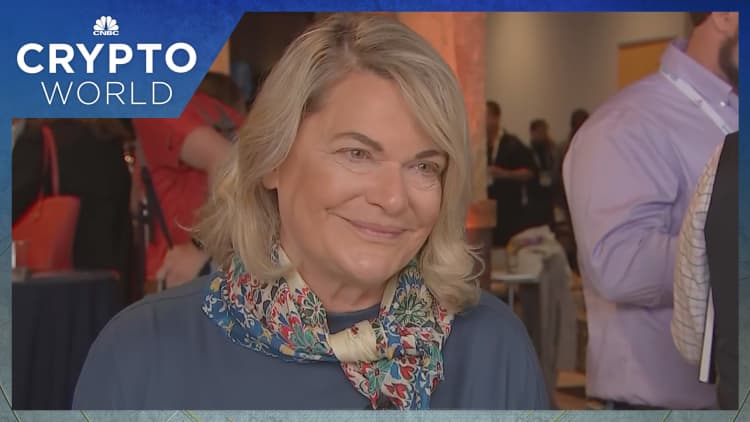
Senator Lummis on the Crypto Oversight Bill and why stablecoins need to be backed by hard assets

maintaining financial stability

Central bankers and US lawmakers have for years lamented the rise of stablecoins, a specific subset of cryptocurrencies whose value is pegged to a real-world asset such as a fiat currency like the US dollar or a commodity like gold.

These non-government digital tokens are increasingly being used in domestic and international transactions, which is scary for central banks as they have no say in regulating this space.

In May, the collapse of TerraUSD, one of the most popular dollar-pegged stablecoin projects, cost investors tens of billions of dollars as it pulled out in a panic some have compared to a bankrun. Widespread buy-in — and public PSAs — from reputable financial institutions lent credence to the project and further pushed the narrative that it was legit.

The implosion of this stablecoin project resulted in a series of bankruptcies that wiped out nearly $600 billion in assets, according to the White House.

“Digital assets and the mainstream financial system are becoming increasingly intertwined, creating channels for turmoil that have spillover effects,” the White House factsheet said.

The framework continues to single out stablecoins, warning that they could create disruptive runs if not paired with proper regulation.

To make stablecoins “more secure,” the administration says the Treasury “will work with financial institutions to strengthen their ability to identify and mitigate cyber vulnerabilities by sharing information and promoting a wide range of datasets and analytical tools, as well.” partner with other agencies to “identify, track and analyze emerging strategic risks associated with digital asset markets.”

This effort is also being conducted jointly with international allies, including the Organization for Economic Co-operation and Development and the Financial Stability Board.
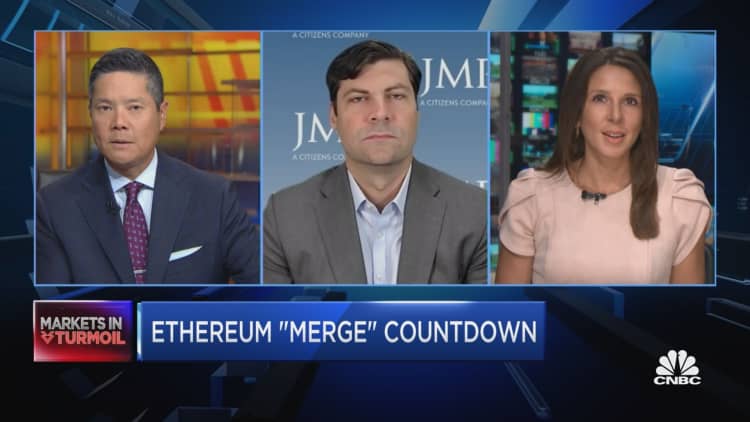
Two crypto experts say the merger of the Ethereum network is crucial for the future of the currency

A pair moved to Mexico from California and saved $1,500 a month

More than 360,000 residents left California in 2021 in what some are calling “the California Exodus.” Many moved to states like Texas, Arizona and Washington.

Some Californians are even leaving the country and making their way to Mexico to live a more affordable lifestyle.

Travis Grossi, a YouTube content creator who runs the Cafe con Leche Travels channel, and David Simmons Jr., a singer-songwriter, relocated to Mexico from California in 2021 and are now saving about $1,500 a month.

Watch this video to learn how.

More from Invest in You:
How this entrepreneur quit her job to now teach people how to afford anything
Crypto is here. Are you ready?
That’s why Americans can’t manage their money

SIGN IN: Money 101 is an eight-week financial freedom learning course delivered to your inbox weekly. For the Spanish version, Dinero 101, click here.

Disclosure: NBCUniversal and Comcast Ventures are investors in Acorns.

This physique scrub prices 50 cents and has greater than 18,300 5-star evaluations

We have independently selected these products because we love them and we think you may like them at these prices. E! has affiliate relationships, so we may earn a commission if you buy something through our links. Items are sold by the retailer, not E!. Prices are correct at time of publication.

You can apply the best body lotion in the world, but there’s no point if it’s just sitting on layers of dead skin. It might seem counterintuitive, but exfoliation is the key to softer skin. As a self-proclaimed artificial tanning expert, I know the importance of exfoliation all too well. I’ve tried so many expensive products, scented scrubs, and to be honest, they all seemed the same to me for a while. However, I’ve finally found an affordable exfoliant that really works in an incredible, yet extremely satisfying way.

Ditch the scrub and opt for this exfoliating mitt from Goldsangsa instead. I was disgusted when I saw the amount of dead skin that came off with the first use, but when I got out of the shower my skin was incredibly soft. The lotions and oils I’ve always used seemed to work even better after using this glove. If you ask me for recommending a $4 product, I won’t blame you, but I’m not the only one interested. It has over 18,300 5-star Amazon reviews.

This is not a disposable product. You can wash and dry it so you can use it again and again. Also, a pack of eight costs $4, which means you’re spending 50 cents per glove. You need to check this.

DOJ prosecutor modifications might land extra executives in jail

The Coat of Arms of the US Department of Justice (DOJ) is seen at its headquarters in Washington, DC, the United States, on May 10, 2021.

Andrew Kelly | Reuters

The way federal prosecutors handle white collar crime cases will change significantly, with a greater focus on individual executives who commit fraud, a senior Justice Department official said Thursday.

According to the official, the DOJ is changing the incentive structure for companies that deal with the government on cases of corporate wrongdoing. The government will give credit to companies that provide information and names of individual executives involved in criminal activities, the official said.

“The timeliness of information about key individuals will be a key metric for prosecutors assessing what credit companies receive for their cooperation,” the official said. “If the company comes forward, people can go to jail and that’s the intent here. But the company itself can avoid a guilty plea on behalf of its shareholders.”

The department also plans to make it significantly more difficult for companies to obtain back-to-back no-tracking agreements. Now prosecutors weigh the full spectrum of a company’s past behavior when making decisions about resolutions.

“Historically, there have been concerns that some companies view resolutions with the Department of Justice as a cost to doing business and believe that multiple back-to-back agreements to not prosecute or to defer prosecution are possible,” the official said. “We’re trying to send a message that’s not the case.”

And the DOJ will also emphasize recovering executive compensation so that when a company foots the bill for a fine, the executives who committed the fraud pay a price, not just the company’s shareholders.

New rules are also expected for corporate compliance monitors, who are often tasked with making sure companies continue to do their best in the wake of misconduct.

Assistant Attorney General Lisa Monaco will present the new guidelines Thursday night at New York University.

Patagonia’s founder donates the whole firm to the struggle in opposition to local weather change

Patagonia founder Yvon Chouinard, his wife and two adult children are giving away their ownership of the apparel manufacturer he founded some 50 years ago, dedicating all of the company’s profits to projects and organizations that protect wild lands, biodiversity and fight the climate crisis.

According to the New York Times, the company is valued at about $3 billion.

In a letter about the decision, published on Patagonia’s website Wednesday, Choiunard wrote about “rethinking capitalism,” saying:

“While we are doing our best to address the environmental crisis, it is not enough. We had to find a way to put more money into fighting the crisis while keeping the company’s values ​​intact. One option was to sell Patagonia and donate all the money.” But we couldn’t be sure that a new owner would maintain our values ​​or employ our team of employees around the world.

Another way was to take the company public. What a disaster that would have been. Even well-intentioned public companies are under too much pressure to seek short-term profits at the expense of long-term vitality and responsibility.

To be honest there weren’t any good options. So we created our own.”

The privately held company’s stock will now be owned by a climate-focused trust and a group of nonprofits called the Patagonia Purpose Trust and Holdfast Collective, respectively, the company said in a statement, noting, “Every dollar not reinvested back into Patagonia.” are paid out as dividends to protect the planet.”

Degrowth: Is it time to live better with less?

The trust will receive all voting stock, representing 2% of the total, and will use it to create a “more permanent legal structure to enshrine Patagonia’s purpose and values.” It is overseen by family members and close advisors.

The Holdfast Collective owns all non-voting shares of Patagonia, which is 98%.

Patagonia expects to generate and donate approximately $100 million annually, dependent on the health of the company. The company now sells new and used outdoor clothing, equipment for outdoor activities such as camping, fishing and climbing, and sustainably sourced food and beverages.

As a certified B-Corp and California Benefit Corporation, Patagonia has donated one percent of its sales to grassroots activists each year and intends to continue to do so. Fewer than 6,000 companies worldwide are certified as B Corp companies. You must meet strict environmental, social and governance standards and benchmarks set by B Labs to earn certification.

Ryan Gellert will continue as Patagonia’s CEO, and the Chouinard family will remain on Patagonia’s board of directors, following the apparel manufacturer’s expanded philanthropic strategy. After notifying employees of the move on Wednesday, the company updated its website to state that “Earth is now our sole shareholder.”

Why climate change could lead to a financial crisis (and what we can do about it

How the position of nationwide treasure was excellent for Catherine Zeta-Jones

The National Treasure series has secured a Hollywood treasure.

In an exclusive interview with E! News at the D23 fair, Catherine Zeta Jones shared what National Treasure fans can expect from her upcoming role in the Disney+ spin-off series, titled National Treasure: Edge of History.

After calling the film franchise “memorable, funny, iconic and legendary,” Catherine promised the new series will be too, adding, “It’s a lot of fun. We take this concept; we really bring it to the present day.”

And as the Chicago actress tells E! News, many changes are to be expected, including her character. “I’m not playing a character that was in those movies,” she explained. “Well, I just had a lot of fun. I just had fun.”

Mentioning that the role is “right up my alley” as she’s also a history buff as she’s “just looking for treasure all the time. I am always an antique dealer.”

What to expect from the series is told, according to the official synopsis, “from the point of view of a young heroine, Jess, a brilliant and imaginative DREAMer in search of answers about her family – who embarks on the adventure of a lifetime to… uncover the truth about the past and rescue a lost Pan-American treasure.”

Professional athletes Isaiah Thomas and Dexter Fowler talk about prime cash ideas

painter apaso | Istock | Getty Images

HUNTINGTON BEACH, Calif. – Professional athletes face a difficult task early in their careers – learning to manage large sums of money as they rise to stardom, often at a young age.

Isaiah Thomas, an all-star basketball player, and major league baseball player Dexter Fowler sat down with CNBC at the Future Proof Wealth Festival to talk about the money lessons they’ve learned throughout their careers. Financial advisor Joe McLean, who works with Fowler and Thomas, also shared advice from working with wealthy athletes like NBA star Klay Thompson and pro golfer Sergio Garcia.

Here are six of their top money tips.

1. Save more than you spend

Isaiah Thomas during the 2016 NBA All-Star Game.

Elsa | Getty Images Sports | Getty Images

“When I got money when my professional career started, the most important thing I learned was learn how to save,” said Thomas, 33, a point guard who is currently a free agent. He has played for many teams over his decade-long career and was a two-time NBA All-Star during a stint with the Boston Celtics from 2014-2017.

When his first paychecks came in, Thomas and McLean set parameters: 70% of every net dollar was allocated to a savings pot. This made saving automatic, said McLean, founder and CEO of San Ramon, Calif.-based Intersect Capital, which was ranked 94th on the 2021 CNBC Top 100 Financial Advisors list.

“Saving more than you spend was our philosophy every month,” Thomas said.

More from Personal Finance:
The 4 big factors affecting the markets and economy right now
Harvard grantee says crackdown on ‘buy now, pay later’ lenders is good news
5 ways to save amid record food price inflation

The percentage saved can change depending on the athlete and the stage in their career, McLean said. It could be 40% on a player’s first contract, 60% to 70% on their second and 80% on their third and beyond because “cash flow is so high at this point,” McLean said.

This approach helps players choose the lifestyle they want to live “before your lifestyle chooses it for you,” he added.

“You have to make the decision from the start” to build a habit, he said.

2. “Always prepare for rainy days”

“Always prepare for rainy days,” said Fowler, 36, an outfielder who won a World Series with the Chicago Cubs in 2016. He is currently a free agent.

“You never know what’s going to happen,” he added. “You [could] get into a car accident; you could stop working.

“Hope for the best, but prepare for the worst.”

Dexter Fowler during game seven of the 2016 World Series.

Gregory Shamus | Getty Images Sports | Getty Images

Fowler describes himself as a lifelong savior. As a young boy, he kept family members’ physical birthday checks because he didn’t know they needed to be cashed.

“People live in the moment,” he added. “Don’t get me wrong, got your vice.

“I like watches; that’s my vice, but I don’t have 10 vices,” Fowler said. “This is how you go crazy; you will spend money, but spend it right.”

3. Think about the financial implications

For people who make significant amounts of money, there are no immediate consequences of bad financial decisions, McLean said.

“You may have a big Amex bill, [you’re] swipe, make some big purchases, but because money is still coming in, the card still works,” he said. “You don’t feel it.”

As McLean explains, “The laws of finance don’t obey the laws of physics.”

This is what happens in sports: you save a lot of money, but you have a great lifestyle and you don’t let it get worse.

Joe McLean

Founder and CEO of Intersect Capital

“If you walk over a log, you have to watch where you’re going, and if you take your eyes off it, you’ll fall in the water,” he said. “If you lose sight of your money, if you make a lot of money, nothing happens.”

Until the money runs out, that is.

“A lot of athletes think it’s never going to stop or it’s never going to end,” Fowler said Tuesday during a Q&A session at Future Proof. “But it does.”

4. “Live like you’re already retired”

“Live like you’re already retired,” Fowler told CNBC.

The thought is: If you overspend during your working years, it’s difficult to transition to a more frugal lifestyle later – which may be necessary for someone who doesn’t have the nest egg to fund lavish expenses.

With that mindset, “you don’t have to change your lifestyle once you’re retired,” Fowler said.

“And it’s hard to do,” he added. “You’re in locker rooms and clubhouses… [and] You see a guy riding in a [Lamborghini].

“You think I make seven times what you do and I don’t feel like I can afford it.”

5. Earn interest on your money

Thomas and Fowler, both in their 30s, have long investment horizons — and that’s a strong thing, McLean said.

Time harnesses the power of compound interest calculated on principal plus accrued interest – meaning your investment gains accumulate faster.

“That’s what happens in sports: you save a lot of money, but you have a great lifestyle and you don’t let that get worse,” McLean said. “Let this money earn interest for another 10 years, double it again, [then another] Time it becomes a multi-generational fortune.”

In comparison, “you’re not going to allow the compounding effect” by continuing to spend big and run down a portfolio over the next decade, he said.

Fowler puts this idea into practice.

“We want to save these next 10 years,” he said of his family. “We reduced everything.”

6. Look beyond the flat rate

Fowler received a nearly $1 million signing bonus in 2004 when he was drafted by the Colorado Rockies. He was just out of high school, 18 years old and got his first contract, he said.

“You sit there and think I have $1 million?” he said. “A million dollars was a lot of money back then.”

“But $1 million doesn’t get you very far,” he added.

The same principle may apply to everyday retirees — a $1 million nest egg may sound like a plentiful sum of money to make a great living, but it may not go as far as people expect from a retirement spanning three decades or can take longer.

When Fowler received his signing bonus, he immediately wanted to buy a car. All of the newly drafted players bought Escalades and Range Rovers — so he bought a Range Rover, against the advice of his father, who recommended leasing rather than buying a car, Fowler said. (Fowler now exclusively rents his cars; he has two Teslas. Cars are “depreciations,” he explained.)

The tax has also eaten up a significant portion of his signing bonus, Fowler added. Playing minor-league ball post-draft, he then realized it’s difficult to make a living on that salary, which was earning him about $300-$400 every two weeks — making the bonus essential to get over to make ends meet.

“I’ve seen a few guys get off-season jobs,” he said. “I was lucky that I didn’t have to do that.”

Biden’s approval ranking surges as his successful streak continues

Joe Biden had a big smile on his face yesterday as he looked at the new electric vehicles rolling off the assembly line. Biden always smiles when it comes to American cars, but he should also smile because things are looking up, including his approval ratings.

It was terribly bleak that summer when, fair or not, Americans couldn’t drive three blocks without being constantly reminded that life was far more expensive and therefore harder. It was July, Biden had yet to sign the Reconciliation Act, which included a massive block of the Build Back Better plan. His approval rating was 36% with midterms just four months away.

Now the gas price has fallen every day since mid-summer. Biden won his once-in-a-generation legislature victory at Build Back Better, he took off his gloves fighting for democracy, stole “Brandon” from Republicans when he became “Dark Brandon,” he is fighting for women at risk and LGBTQ Groups , Trump is on the run, all of which contributes to a Biden approval rating that has skyrocketed nine points at 45% approval.

The midterms are in two months. Anything can happen, but if trend is your friend, going into Election Day with 50% approval or more would be awesome.

From the AP:

President Joe Biden’s popularity has improved significantly since his trough this summer, but concerns remain about his handling of the economy, according to a poll by the Associated Press-NORC Center for Public Affairs Research.

Support for Biden rebounded to 45% from a low of 36% in July, in large part due to a rebound in support from the Democrats just two months before the November midterm elections.

Undoubtedly, the economy and inflation are big issues this fall, but it’s not as dominant an issue as Republicans would like it to be, not when women’s and LGBTQ rights are at stake. And in a sign that bodes well for democracy, Democrats and Joe Biden, a recent poll in late August showed the threat to democracy was the biggest concern in the midterm elections.

This is all good news for Democrats. Republicans continue to increasingly nominate extreme abstainers, and Republican extremism has taken root in the form of the Dobbs decision, showing how insane some of the Red States’ laws can be when unleashed. In such an environment, there will be somewhere between 60% and 66% of Americans in general who prefer adults in government and therefore will inevitably have to vote democratically.

The worse Trump looks, the more that “mad Trump” makes headlines, the more likely Biden’s poll numbers are to rise. We saw the same phenomenon with President Obama, whose approval ratings skyrocketed when the Republican primary focused on Trump and Ted Cruz, and Obama left office with a 59% approval rating while Trump took office with just 45% . Trump, as the head of all “Republicans,” dominates the political discourse so much that the same pattern should apply to Biden. If Trump turns out to have more records, or more damning evidence emerges, we’ll likely see Biden and Democrat support rise.

And that’s exactly how you want to lean if you want to retain control of the Senate (increasingly likely) and try to save the House of Representatives (now possible).

@JasonMiciak believes a day without learning is a day not lived. He is a political writer, columnist, author and lawyer. He is a Canadian-born dual citizen who spent his teens and college days in the Pacific Northwest and has since lived in seven states. Today he enjoys life as a single father to a young girl and writes on the beaches of the Gulf Coast. He loves making his flower pots, cooking and is currently studying philosophy of science, religion and non-mathematical principles behind quantum mechanics and cosmology. Please do not hesitate to contact us for lectures or other concerns.

Jersey Shore’s Snooki Says Sammi “Sweetheart” Blocked Her

Even the Jersey Shore crew isn’t spared from family drama.

As the cast of MTV’s reality show continue to document their lives, some viewers are wondering if they’re an original cast member Sammi “Honey” Giancola will always come back for a visit. Corresponding Nicole “Snooki” Polizziher former co-star really isn’t interested.

“We tried to get her back about two years ago and we all texted her and said, ‘Come over for dinner. Why not?’” Nicole exclusively shared with E! News. “And she’s just like, ‘No, I’m never going to do that show again.’ We didn’t want to push it.”

But recently Nicole decided to check back in and was surprised at what she found.

“I was going to message her a while ago and she blocked me,” Nicole said. “I don’t know what I did. It’s unfortunate because we’d love for her to come back. She’s part of the show. I feel like it’s not crowded unless we’re all there. It is sad.”

E! News has reached out to Sammi’s rep for comment and has not yet received a response.

Proper-wing events win Swedish election; Prime Minister Magdalena Andersson resigns

Andersson became Sweden’s first female prime minister last year and spearheaded the country’s historic bid to join NATO following Russia’s attack on Ukraine.

Jessica Gow | AFP | Getty Images

Swedish Prime Minister Magdalena Andersson has conceded defeat in the country’s hard-fought elections, paving the way for the far-right Sweden Democrats and allied parties to attempt to form a government.

The centre-left Social Democrats, led by Andersson, received 30.3% of the vote, confirming their position as the country’s largest party with almost all the votes counted.

However, the left-leaning parties – the Social Democrats and three others – failed to secure a majority in Sweden’s 349-seat parliament.

Instead, it looks like a right-wing group of parties led by Ulf Kristersson’s centre-right moderates have won a narrow majority of the seats and will make the first attempt to form a government.

This so-called “blue bloc” includes the anti-immigrant Sweden Democrats. The party, once shunned by the political establishment, recorded its best-ever election result with 20.5% of the vote.

It marks a historic turning point in Swedish politics.

The Sweden Democrats are now poised to gain influence over government policy. The Nationalist Party has championed law-and-order issues following a rise in gun violence, promising longer prison sentences and reducing immigration.

Sweden, a Scandinavian country of around 10.5 million people, has a reputation for being one of the most progressive countries in Europe and is consistently ranked among the happiest nations in the world.

Andersson worried for years to come

At a press conference on Wednesday, Andersson announced her intention to resign, saying the right-wing bloc has a seat or two advantage. “It’s a thin majority, but it’s a majority.”

“Most opinion polls told us it was going to be a close race in the election, so I wasn’t surprised it went that way rather than the other way around,” Andersson said. “I knew that could happen, but of course I’m worried about how things will develop in the next few years.”

Andersson became Sweden’s first female prime minister last year and spearheaded the country’s historic bid to join NATO following Russia’s attack on Ukraine.

She criticizes the rising popularity of the Sweden Democrats and warns that such a party in government could have a major impact on the tone of political debate.

Jimmie Akesson, leader of the Sweden Democrats, said his party is a “constructive and driving force” in rebuilding security in the country, Sky News reported. He added it was “time to put Sweden first”.

Sweden has a reputation for being one of the most progressive countries in Europe and is consistently ranked among the happiest nations in the world.

Jonathan Nackstrand | AFP | Getty Images

The Sweden Democrats emerged from the country’s neo-Nazi movement in the late 1980s and have since struggled to distance themselves from accusations of extremism. In 2010, the party was represented in the Reichstag for the first time.

A gradual increase in national support thereafter prompted the centre-right Moderate Party to forge a partnership with the Sweden Democrats in 2018. Kristersson’s moderates had previously ruled out negotiations with the right-wing party.

Kristersson said Wednesday he would begin forming a new government “that can get things done,” Reuters reported.

However, somewhat complicating the picture is the fact that the Liberals and Sweden Democrats – both part of the right-wing bloc – refuse to participate in government together.

“A very unstable coalition”

“I think that eventually there will be some form of Sweden Democrat representation in the government, but that will lead to a very unstable coalition,” Anamaria Dutceac Segesten, a lecturer in European studies at Lund University in Sweden, told CNBC by phone.

Even if that doesn’t happen through a ministerial position, Dutceac Segesten said the Sweden Democrats would likely influence the agenda of a future government led by Kristersson the Moderate.

“It’s always complicated,” she added. “In 2018 it took three months before we had a Swedish government. It wasn’t until December that we actually had a proper coalition, and it was an unstable coalition – one that had two votes of no confidence and changed prime ministers.”

Dutceac Segesten said a shaky start for the previous government is likely a sign that a new government is about to be formed.

Jimmie Akesson, leader of the Sweden Democrats, reportedly said his party is a “constructive and driving force” in rebuilding security in the country.

Jonathan Nackstrand | AFP | Getty Images

Prianthi Roy, an analyst at the Economist Intelligence Unit, a research and consultancy firm, told CNBC that the most likely outcome of the election is a centre-right government led by the Moderates in coalition with the Christian Democrats and the Liberals.

“The Sweden Democrats, now the second largest party in parliament, are likely to remain outside government but support the coalition in parliament in exchange for political concessions, including tougher asylum rules,” Roy said via email.