Die Zölle der US-Bundesstaaten steigen, da Trump während der Halbzeitwahlen mit einem Kampf um die Erschwinglichkeit konfrontiert ist

Eine neue Analyse der US-Volkszählungsdaten zeigt, dass Bundesstaaten in den USA, in denen in diesem Jahr wichtige Zwischenwahlen stattfinden, im Zeitraum seit Beginn der Einführung weitreichender Handelszölle durch Präsident Donald Trump im März 2025 bis zum letzten November Zölle in Höhe von über 134 Milliarden US-Dollar gezahlt haben. Insgesamt zeigten die von Trade Partnership Worldwide zusammengestellten US-Volkszählungsdaten, dass Staaten in diesem Zeitraum Zölle in Höhe von insgesamt 199 Milliarden US-Dollar zahlten.

Trump hat die Erschwinglichkeit als „demokratischen Schwindel“ bezeichnet, und in einer jüngsten Aussage vor dem Kongress sagte Finanzminister Scott Bessent, dass die Zölle „keine Inflation verursachen“.

Die von der Bundesregierung eingenommenen Zolleinnahmen sind sprunghaft angestiegen, wobei die USA im Januar Zölle in Höhe von 30 Milliarden US-Dollar einführten, seit Jahresbeginn sind es 124 Milliarden US-Dollar, 304 % mehr als im gleichen Zeitraum im Jahr 2025.

Es wird jedoch erwartet, dass Trumps Zölle und die Erschwinglichkeit Faktoren im bevorstehenden Zwischenwahlzyklus sein werden. Jüngste CNBC-Umfragedaten zu amerikanischen Verbraucher- und Preisdaten zeigen, dass die Probleme mit der Erschwinglichkeit real sind und viele Wähler die Wirtschaft verärgert haben. Eine im Januar von der New York Times und der Universität Siena durchgeführte Umfrage ergab, dass 54 % der Wähler die Zölle von Trump ablehnen. Einige Mitglieder der GOP beginnen mit ihren Führern in der Zollfrage zu brechen und stimmten am Dienstag gemeinsam mit den Demokraten für die Ablehnung einer Regel, die es dem Repräsentantenhaus verboten hätte, die von Trump erlassenen Zölle anzufechten. Es wird erwartet, dass das Repräsentantenhaus am Mittwoch über eine Maßnahme zur Aufhebung von Trumps Zöllen auf Kanada abstimmen wird, die vom Abgeordneten Gregory Meeks, DN.Y., eingeführt wurde.

„Amerikaner, die mit der Erschwinglichkeit zu kämpfen haben, machen zu Recht die Zölle für höhere Preise bei vielen alltäglichen Einkäufen verantwortlich“, sagte Dan Anthony, Geschäftsführer der Kleinunternehmenskoalition „We Pay the Tariffs“ und Präsident von Trade Partnership Worldwide. „Der Präsident könnte in den Staaten, die über die Wahlen 2026 entscheiden, Dutzende Milliarden Steuern abschaffen. Er will das einfach nicht“, sagte Anthony.

Top-Staaten und Tarifrechnungen

  • Kalifornien: 38 Milliarden US-Dollar
  • Texas: 21 Milliarden US-Dollar
  • Michigan: 13 Milliarden US-Dollar
  • Georgien: 12 Milliarden US-Dollar
  • Illinois: 9,6 Milliarden US-Dollar
  • Ohio: 6,5 Milliarden US-Dollar
  • Pennsylvania: 6,3 Milliarden US-Dollar
  • North Carolina: 5 Milliarden US-Dollar
  • South Carolina: 5,2 Milliarden US-Dollar
  • Kentucky: 4 Milliarden Dollar

In diesem Jahr stehen alle 435 Bezirke des US-Repräsentantenhauses und 33 Sitze im US-Senat zur Wahl. Die Republikaner verfügen in beiden Kammern des Kongresses über knappe Mehrheiten. Die Demokraten müssen vier Sitze gewinnen, um eine Mehrheit im Senat zu gewinnen. Um die Kontrolle über das Repräsentantenhaus zu behalten, kann es sich die Republikanische Partei nicht leisten, mehr als zwei Sitze zu verlieren.

Die Vorwahlsaison der Zwischenwahlen beginnt am 3. März, wenn die Wähler in Arkansas, North Carolina und Texas zur Wahl gehen.

Kleine Unternehmen in ganz Amerika sind von den Zöllen hart betroffen

Kleinunternehmer in allen US-Bundesstaaten äußern sich zu den Auswirkungen der Zölle auf ihre Unternehmen, einige davon im Rahmen einer neuen YouTube-Videokampagne mit dem Titel „Small Businesses Against Tariffs“, die am Mittwoch gestartet wurde, um das Bewusstsein zu schärfen.

Viele kleine Unternehmen versuchen, der Rhetorik entgegenzuwirken, dass Zölle von anderen Unternehmen und nicht von der Main Street gezahlt würden, und argumentieren mit der Idee, dass Zölle an die Amerikaner zurückgezahlt werden, indem sie darlegen, wie die Zölle tatsächlich funktionieren und wer den Preis zahlt – ihrer Ansicht nach amerikanische Kleinunternehmen, Arbeitnehmer und Verbraucher.

Chris Gibbs, ein Landwirt aus Shelby County, Ohio, der Mais, Sojabohnen, Weizen, Luzerneheu und einen Betrieb mit 90 Kühen und Kälbern anbaut, sagte, die Zölle hätten ihn gleich doppelt getroffen. „Meine Betriebskosten steigen rasant“, sagte Gibbs. „Zölle auf Stahl, Aluminium und Schnittholz erhöhten die Kosten für alles, was ich tue. Vom Bau von Gebäuden und Scheunen über den Kauf von Maschinen, Anhängern, Rädern und Teilen bis hin zu meinem Dünger“, sagte er.

Ein Mähdrescher schneidet, drischt und reinigt Sojabohnen während einer Ernte in Waynesfield, Ohio.

Matthew Hatcher | Bloomberg | Getty Images

Gibbs sagte, der Handelskrieg habe auch seine Fähigkeit, seine Ernte zu verkaufen, beeinträchtigt.

„Im Jahr 2018 zerstörte dieser Präsident die Handelsbeziehungen, und in diesem Moment wurden wir, genau wie Carter im Jahr 1980 mit dem russischen Embargo, zu einem unzuverlässigen Lieferanten. Hier sind wir, und wir haben uns nicht erholt“, sagte Gibbs. „Brasilien ist jetzt der Hauptlieferant von Sojabohnen für China. Trump drängte Präsident Xi in die Arme Brasiliens und sie gingen nie weg.“

Versprochene Agrarkäufe waren ein wichtiger Teil des ersten Handelskrieges zwischen den USA und China. China ist seinen Verpflichtungen bei Agrarkäufen nicht nachgekommen. Im Jahr 2025 versprach China eine Steigerung der Bestellungen, doch Handelsdaten zeigen, dass es keinen nennenswerten Anstieg gegeben hat.

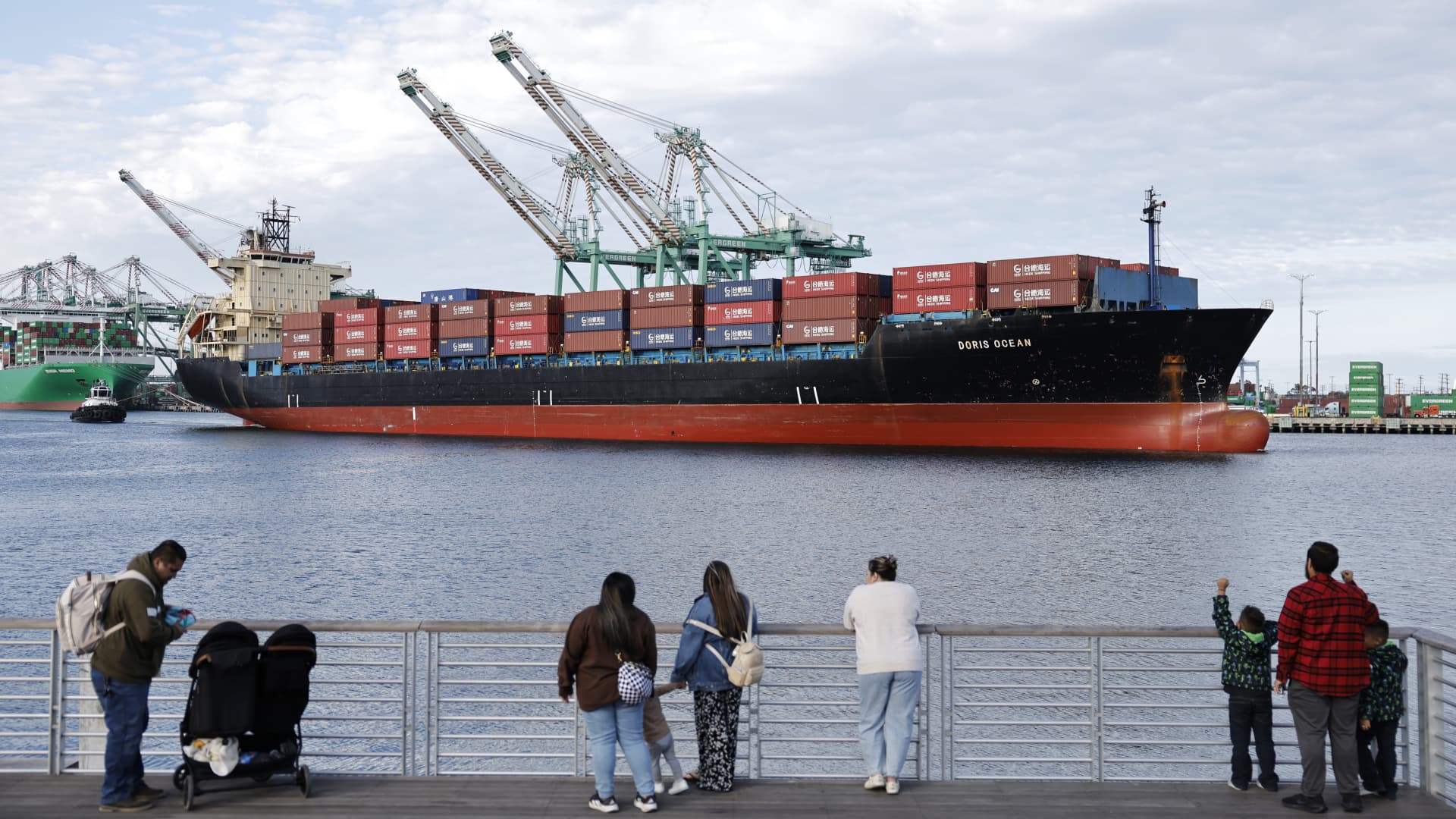
Noel Hacegaba, CEO des Hafens von Long Beach, sagte gegenüber CNBC, dass die Sojaexporte nach China im Jahresvergleich um 95 % zurückgegangen seien.

„China verbraucht mittlerweile den Großteil seiner Sojabohnen aus Ländern wie Brasilien“, sagte Hacegaba. „Die Vereinigten Staaten produzieren etwa 20 Prozent der weltweiten Sojabohnen. Brasilien liegt jetzt bei 40 Prozent, größtenteils weil China seine Einkäufe nach Brasilien verlagert. Als wichtiges Exporttor tun wir alles, was wir können, um unseren Exporteuren zu helfen, ihre Produkte effizienter zu transportieren, aber wir brauchen Gewissheit und Klarheit in der Handelspolitik, um sicherzustellen, dass dieses Produkt transportiert werden kann“, sagte er.

Gibbs sagte, die Zollhilfen, die Trump den Landwirten versprochen habe, seien ein Schlag ins Gesicht für alle Landwirte und Amerikaner. „Wenn diese Schecks jemals kommen, dann ist das das Geld, das ich für die Zölle ausgegeben habe, genau wie alle amerikanischen Verbraucher“, sagte Gibbs.

Wie Trumps Handelskrieg den Frachtmarkt beeinflusst: CEO von Port of Long Beach

Bei Hiblow USA mit Sitz in Saline, Michigan, das sich auf lineare Luftpumpen für die Abwasseraufbereitung und Klärgrubenbelüfter spezialisiert hat, die in den gesamten USA in privaten Abwasseraufbereitungssystemen für ländliche und vorstädtische Haushalte eingesetzt werden, belief sich die Tarifrechnung des Unternehmens im Jahr 2025 auf 1,2 Millionen US-Dollar. Tim Smith, Präsident, sagte, die Unsicherheit über die Langlebigkeit der Tarife habe ihn gezwungen, Expansionspläne zu stoppen. Das Unternehmen im Südosten von Michigan beschäftigt zehn Mitarbeiter und der zusätzliche Standort hätte drei bis vier neue Arbeitsplätze geschaffen. „Wir sind ein kleines Unternehmen, und obwohl einige vielleicht denken, dass es nicht viele Jobs gibt, handelt es sich um gut bezahlte Jobs“, sagte Smith.

„Wir haben nur 40 Prozent unserer Kosten an die Kunden weitergegeben“, sagte Smith. „Es ist zu einem Konkurrenzkampf zwischen den Unternehmen geworden, wer durchhalten und mehr Geld verbrennen und diese Zölle absorbieren kann. Aber ich denke, niemand kann langfristig durchhalten und die Zölle absorbieren“, fügte er hinzu.

Das Unternehmen importiert seine Produkte aus den Philippinen. Das Land hat noch keine Einigung über Zölle mit den USA erzielt, doch am Montag diskutierten Vertreter beider Länder in Manila über einen Zollsatz von 19 % auf philippinische Waren.

Smith sagte, dass veränderte Zollsätze auch eine zusätzliche Belastung für seine Zollagenten darstellten. „Wir mussten unsere Zollanleihen zwei- oder dreimal erneuern, weil wir den Anleihen mehr Mittel hinzufügen mussten“, sagte Smith. „Das hat uns daran gehindert, einige unserer Container zu bekommen, weil die Kaution in der Schwebe war. Ohne Ihre Zollkautionen können Sie nichts verarbeiten.“

Zollbürgschaften, auch Bürgschaftsbürgschaften genannt, bieten Importeuren Schutz und garantieren die Zahlung von Zöllen und Steuern, die auf importierte Waren erhoben werden. Der Wert dieser Anleihen und der damit verbundenen Sicherheiten ist im Zuge der von der Trump-Administration erhobenen höheren Zölle stark gestiegen. Wenn eine Kaution nicht über ausreichende Mittel verfügt, kann der Importeur die Fracht nicht in Besitz nehmen.

Auch wenn der Oberste Gerichtshof entscheidet, dass viele von Trumps Zöllen illegal sind und Rückerstattungen an Unternehmen erfordern, wobei eine Entscheidung am 20. Februar möglich ist, sagt Smith, er wisse, dass die Trump-Regierung noch weitere Zölle in der Warteschleife habe, so dass es keine Liquiditätsentlastung geben werde.

„Wir haben unser Geld immer problemlos über den Zoll zurückerstattet bekommen“, sagte Smith. „Manchmal hat es bis zu einem Jahr gedauert, aber es gibt sicherlich einen Rahmen dafür. Aber ich kann Ihnen sagen, dass wir sicherlich keine Geschäftspläne auf der Grundlage einer Entscheidung machen, dass wir unser Geld zurückbekommen könnten. Es sind weitere Zölle auf dem Weg, wenn sie für illegal erklärt werden.“

In New York schloss Spielwarenladenbesitzerin Jennifer Bergman ihr von ihrer Mutter gegründetes West Side Kids nach 44 Jahren wegen der Zölle. „Der Großteil unserer Spielzeuge wird in China hergestellt, daher haben die Zollkosten unser Geschäft übernommen“, sagte Bergman. „Wir erhielten ständig E-Mails von unseren Lieferanten mit Preiserhöhungen und mussten daher unsere Preise erhöhen.“

Ein Beispiel waren ihre Rollerbestellungen. Bergman sagte, das Unternehmen verkaufe normalerweise jedes Jahr Roller im Wert von 50.000 US-Dollar. Nach den Zöllen besaß sie keinen Roller mehr, der unter 200 US-Dollar kostete, was sich nicht nur auf ihre Verkäufe, sondern auch auf ihre Lagerbestände auswirkte. „Die Preise für Roller sind um 30 Dollar gestiegen“, sagte Bergman. „Ich erhielt einen Anruf von meiner Rollerfirma und sie teilten mir mit, dass sie ihre Container wegen der Zölle nach Kanada umleiten würden und sie nicht mehr einführen würden, bis die Zölle niedriger seien“, fügte sie hinzu.

Ende Mai, sagte Bergman, habe sie begonnen, sich ihre Zahlen anzusehen, und ihr sei klar geworden, dass sie die Miete für Juli nicht bezahlen könne. „Der Juni war normalerweise einer meiner geschäftigsten Monate … aber der Juni war einfach tödlich. Ich konnte mir den zu verkaufenden Bestand nicht leisten. Ich rief meinen Vermieter an, und zum Glück hatten wir eine 44-jährige Beziehung mit meinem Vermieter, und ich sagte, ich muss Schluss machen.“

Bergmans Laden schloss Ende Juli.

In Tempe, Arizona, wurde Brick Road Coffee während der Pandemie im Jahr 2021 eröffnet. Gabe Hagen, Mitbegründer und CEO des Coffeeshop- und Röstunternehmens, sagte, er sei jetzt dankbar, dass die Zölle auf Kaffee abgeschafft wurden, aber er habe immer noch Kaffee zum höheren Tarifpreis.

„Wir bestellen monatlich 4.000 Pfund Kaffee, hauptsächlich für zwei Geschäfte, und sehen uns aufgrund der Zölle auf Rohkaffee und andere Lieferungen mit höheren Kosten konfrontiert“, sagte Hagen. „Obwohl wir die Kosten im Coffeeshop decken mussten, mussten wir leider für unsere Rösterei die Preise erhöhen.“

Hagen sagte, dass Großhandelskunden vor der Einführung der Zölle etwa 10 US-Dollar pro Pfund für geröstete Kaffeebohnen bezahlt hätten. Mittlerweile zahlen die Kunden etwa 13,50 Dollar pro Pfund, und er hofft, dass der Höchststand erreicht ist.

Bei den Kaffeetarifen kam es zu erheblichen und schnellen Veränderungen. Die anfänglichen Zölle von 10–50 % reichten vom höheren Ende für Brasilien (50 Prozent) bis zu niedrigeren Zöllen für Indien (25 Prozent), Vietnam (20 Prozent) und Indonesien (19 Prozent).

In einer Durchführungsverordnung vom November 2025 wurden die meisten dieser Zölle, einschließlich der auf Brasilien, abgeschafft, aber Hagen sagte, die Zölle hätten anhaltende Auswirkungen gehabt. Sein Unternehmen hat die Zollkosten gemindert, indem es die Ladenerweiterung verzögerte und Röstgeräte kaufte, bevor die Zölle in Kraft traten. „Wir befanden uns in einer Zeit, in der Bargeld der König sein wird, und als kleines Unternehmen habe ich einfach nicht viel davon“, sagte Hagen. „Also musste ich kürzen, um zu versuchen, die längste Landebahn zu erhalten, die möglich ist, um die Ungewissheit zu meistern.“

Hagen sagt, die Verbraucher würden durch die Verkaufsaktivitäten seines Unternehmens geschwächt. „Wir sehen, dass unser durchschnittlicher Eintrittspreis sinkt“, sagte er. „Obwohl unser Fußgängerverkehr Jahr für Jahr relativ stabil bleibt, ist unser Bruttoumsatz tatsächlich von Jahr zu Jahr niedriger. Die Verbraucher schonen ihren Geldbeutel und kaufen nicht die Extras wie die Muffins. Unser viertes Quartal war schrecklich. Es war das Schlimmste in den vier Jahren, in denen wir geöffnet haben“, sagte er.

Peter Boockvar, Chief Investment Officer von One Point BFG Wealth Partners, sagt: „Die Belastungsstörung aus dem vorherigen Inflationsanstieg ist wieder aufgeflammt. Und wenn sie nicht vollständig an die Verbraucher weitergegeben wird, haben die Unternehmen sie durch niedrigere Gewinnspannen aufgefangen.

Wählen Sie CNBC als Ihre bevorzugte Quelle bei Google und verpassen Sie keinen Moment des vertrauenswürdigsten Namens für Wirtschaftsnachrichten.

The Vertex kidney drug povetacicept is profitable within the examine for IgAN

A sign hangs in front of the world headquarters of Vertex Pharmaceuticals in Boston.

Brian Snyder | Reuters

Vertex Pharmaceuticals said its experimental drug for a rare kidney disease successfully passed a Phase 3 trial, a key step in the company’s journey to diversify beyond its main cystic fibrosis drugs.

The Boston-based drugmaker said Monday that its immunoglobulin A nephropathy drug, povetacicept, reduced levels of a marker of the autoimmune disease by 52% in a late-stage trial. That exceeded the bar set by analysts for Vertex’s drug to compete with a recently approved drug from Japan’s Otsuka and another in the pipeline from the U.S. biotech company Vera Therapeutics. Shares of Vertex rose more than 9% on Tuesday.

“Vertex’s successful study is an important first step toward entering a new market segment in kidney disease,” said Carter Gould, analyst at Cantor Fitzgerald. Vertex is developing two drugs behind povetacicept, and Gould expects the three to generate combined annual sales of more than $10 billion. That could rival Vertex’s cystic fibrosis franchise, which brought in more than $11 billion in sales last year.

“You don’t have to look really hard to see the connections and say this is a pretty meaningful white space that they could grow into,” Gould said.

Vertex has revolutionized the treatment of cystic fibrosis with a portfolio of drugs for the inherited lung disease, but the company has repeatedly faced questions about whether it could replicate that success in other diseases. The company has expanded into blood disorders in recent years with the approval of its gene-editing drug Casgevy and into acute pain with its drug Journavx. Neither has been a resounding success, forcing Vertex to look for other expansion opportunities.

In 2024, Vertex paid nearly $5 billion to acquire Alpine Immune Sciences and its lead program Povetacicept. The drug could treat a rare autoimmune disease called IgAN, which affects the kidneys’ ability to function properly and sometimes causes patients to need dialysis or even a transplant. Vertex also plans to test the drug for several other kidney diseases.

The company expects to complete its application to the U.S. Food and Drug Administration for povetacicept in IgAN by the end of this month. Approval is possible later this year with the use of a priority review voucher.

Choose CNBC as your preferred source on Google and never miss a moment from the most trusted name in business news.

The federal government ought to present extra help to Individuals caught within the Center East

Senator Elizabeth Warren (D-MA), accompanied by Senator Angus King (I-ME) (L), speaks as General Gregory Guillot, commander of the United States Northern Command and the North American Aerospace Defense Command (USNORTHCOM), Mark Ditlevson, deputy assistant secretary of defense for Homeland Security and American Security Affairs, and Charles Young III, deputy general counsel of the War Department, appear at a hearing of the Senate Armed Services Committee on Capitol Hill, December 11. 2025 in Washington, DC

Andrew Harnik | Getty Images

Senator Elizabeth Warren questioned Thursday why U.S. Transportation Command and the State Department are not doing more to get stranded American citizens out of the Middle East amid the war with Iran.

Tens of thousands of U.S. citizens could still be stranded in the region and the Trump administration was too slow to act as violence spread from Iran to surrounding countries, the Massachusetts Democrat said at a Senate Armed Services Committee hearing.

“Let me be clear: The Trump administration chose this war. They planned this war for months and made no plans to protect hundreds of thousands of Americans in the region. There is no excuse for that,” Warren said.

Americans reported feeling stranded in the region in the days immediately following the outbreak of war. A State Department warning to U.S. citizens to “LEAVE NOW” to Americans in 14 countries sparked a row that some said left them on their own. Facing criticism, the State Department said last week that it would expand flights for Americans from the region.

Read more about CNBC’s politics coverage

While President Donald Trump suggested earlier this week that the war would end “very soon,” there is no immediate end in sight and Americans in the region are trying to contend with an ever-evolving regional conflict.

The State Department has provided regular updates on the number of Americans relocated from the region since Trump announced war with Iran on Feb. 28, and on Thursday a spokesman said nearly 47,000 citizens had returned to the United States

The State Department has operated more than two dozen charter flights, and at this point the number of seats offered on those flights exceeds demand, the spokesman said.

“While commercial flight availability continues to improve across the region, U.S. State Department charter flights and ground transportation continue to operate,” the spokesperson, without giving his name, responded to an email sent to the agency’s media inquiries account.

Gen. Randall Reed, commander of TRANSCOM, testified at Thursday’s hearing that his command helped airlift hundreds of Americans from the region.

But Warren said the effort failed.

“I’m trying to understand why you don’t do more,” Warren asked Reed. “Because I’m hearing from my constituents who are stuck there, who have been stuck there for two weeks, asking for help, and they’re not getting any help from the U.S. government.”

Bring Americans home

While many Americans have left the region and some are choosing to remain in the region, others are still stuck. The State Department spokesman said the department is “now working around the clock to bring Americans home.”

Some lawmakers are taking matters into their own hands.

Rep. Nancy Mace, R-R-S.C., reported on X about a trip she took this week to the Middle East to help a family from her district who was stuck there.

“The family I traveled here to care for is home safely. But then I found out about more families. Hundreds of families. Thousands. Still stranded,” Mace wrote.

Congressional clerks, the staff who answer voters’ inquiries, have also reported that Americans feel left behind and frustrated by the federal government’s response to the war.

A Senate Democratic clerk – who spoke on condition of anonymity because she is not authorized to speak to the press – said she had heard from voters in countries including the United Arab Emirates, Qatar, Israel and Kuwait. Some are tourists, others are students or Americans who are in the region for work, sometimes with their families.

“The people there in the Middle East just want to leave, but they have no way of leaving at all. They are afraid, they are scared and they feel abandoned,” said the case worker. “Their families here are frightened and frightened, wondering why the U.S. government hasn’t brought their loved one home already.”

Inconsistent messaging from the administration hasn’t helped, the Senate clerk and a Democratic clerk in the House of Representatives, who also spoke on condition of anonymity, both said.

In the early days of the war, the recommendation for Americans in the region was to shelter in place, the House aide said. But the news “DEPART NOW” on March 2nd caused panic. Many countries in the region had their airspace closed, making commercial flights an unlikely route home. The government provided a telephone number for a hotline, but it took a long time. As they got through, they were told at times they were on their own, the clerk said.

“What we heard from voters was absolute panic,” the House aide said.

Choose CNBC as your preferred source on Google and never miss a moment from the most trusted name in business news.

Los Angeles Marathon about Michael Kimani Kamau Unsuitable flip, no winner

The LA Marathon also congratulated all of the race’s podium finishers – including Enyew Nigatwho took third place on the men’s professional podium, and Priscah Cheronowho took first place in the Women’s Pro Podium – and thanked the over 27,000 runners who took part in the event.

While Kamau has yet to make any public comment about being named runner-upWinner Martin was shocked that he was able to take first place.

“With a mile to go I started seeing the pace car and the leader and said, ‘Maybe we’ll see what happens,'” he said NBC News. “And then there’s another 800, and I’m like, ‘Okay, I have to try, I have to at least try,’ and it kind of worked out.”

Read on to take a look at some of your favorite stars who have run the marathon.

US Treasury yields: Oil returns larger

The 10-year Treasury Department The yield initially rose before falling on Monday as oil prices initially rose above $100 a barrel, then later fell after President Donald Trump told a CBS News reporter that the Iran war could soon be over.

The benchmark 10-year Treasury yield fell more than 2 basis points to 4.109%, and the 30-year Treasury yield fell more than 3 basis points to 4.721%. The two-year Treasury yield was little changed at 3.557%.

One basis point is equal to 0.01%, and yields and prices move in opposite directions.

“I think the war is pretty much over,” Trump said, according to a post on X by Weijia Jiang, senior White House correspondent for CBS News. “They have no navy, no communications, they have no air force.”

After these comments were shared, oil prices fell in extended trading. West Texas Intermediate crude, which hit a high of $119.48 in overnight trading, was last at nearly $87 a barrel and global benchmark Brent was at $91 a barrel. The two had settled higher in the regular session.

The earlier rise in oil prices in the wake of the Iran war has raised fears that rising energy costs could lead to a broader rise in inflation. Some even predict that $100 a barrel could lead to a global recession.

“The market is a little in disbelief,” Warren Pies, co-founder and strategist at 3Fourteen Research, said on CNBC’s “Money Movers,” noting that the market is currently worried about inflation and the Federal Reserve’s interest rate outlook. “It’s probably rational, but basically everything here is priced in for a quick change, and that includes the bond market.”

The rise in oil prices came after Iran, Kuwait and the United Arab Emirates cut oil production after the Strait of Hormuz was effectively closed due to the war that began on February 28.

The group of seven energy ministers will meet virtually early Tuesday to discuss a possible release of oil reserves to combat supply disruptions.

If there is no response and millions of barrels per day are effectively ignored, oil prices will have to rise “to a level that starts to dampen demand and ration that, and that is recessionary,” Pies added. “I think the first indication that we’re at this point in the economy will be [Treasury] Yields begin to decline.

Less immediately, investors expect a busy week of economic data, including February inflation data on Wednesday, followed by January’s personal consumption expenditures index and JOLT job vacancies numbers on Friday.

Federal Reserve officials are in a pre-meeting lockdown ahead of their two-day meeting to decide interest rate policy, scheduled for March 17 and 18.

—CNBC’s Eamon Javers and Spencer Kimball contributed to this report

Choose CNBC as your preferred source on Google and never miss a moment from the most trusted name in business news.

FDA’s vaccine chief will resign in April after a sequence of controversial choices

The Food and Drug Administration logo is seen before a news conference at Health and Human Services headquarters in Washington, April 22, 2025.

Nathan Posner | Anadolu | Getty Images

A key U.S. Food and Drug Administration official who oversees vaccines and biotechnology treatments will resign from the agency after several decisions that raised concerns in the industry.

Vinay Prasad, director of the Center for Biologics Evaluation and Research, will leave the FDA at the end of April, an agency spokesman confirmed Friday. It is his second resignation from the position: He briefly left the post in July after backlash over his regulatory decisions, and returned just two weeks later in August.

In a post on Makary, Prasad said “achieved tremendous things” during his tenure at the agency.

Prasad’s decision to resign came after increasing criticism of the FDA from the biotech and pharmaceutical industries, as well as from former health officials. According to RTW Investments, the agency rejected or discouraged approval applications for at least eight drugs last year after delving into the data the companies used to support their applications. The FDA initially refused to review Moderna’s flu shot, but later changed course.

All of these companies accused the FDA of reversing previous guidance on the evidence they could use to support their applications, sparking industry criticism that an unreliable regulatory process could hamper the development of drugs for hard-to-treat diseases.

A former FDA official, who spoke to CNBC on condition of anonymity to speak freely on the topic, called the retractions the worst kind of regulatory uncertainty because companies say they are told one thing and then experience another.

In a statement earlier Friday, an FDA spokesperson said there is “no regulatory uncertainty,” adding that the agency “makes decisions based on the evidence but makes no representations about the results.” The spokesperson said the FDA “conducts rigorous, independent reviews and does not agree with the approvals.”

The latest controversy arose after the FDA advised against it UniQure disqualified from applying for accelerated approval of its experimental treatment for Huntington’s disease.

The agency, which made staff cuts and reorganization under Health and Human Services Secretary Robert F. Kennedy Jr., has faced broader backlash for its approval process for drugs and vaccines. Critics fear the agency could hinder the development of new treatments and endanger patient safety.

Criticism of Prasad had been mounting, reaching a peak when the FDA’s Makary appeared to criticize UniQure’s gene therapy for Huntington’s disease in an interview with CNBC’s Becky Quick last week. Makary did not name UniQure but described his treatment.

At a CNBC Cures event this week, calls for restructuring grew even louder.

The Wall Street Journal first reported Prasad’s departure.

Choose CNBC as your preferred source on Google and never miss a moment from the most trusted name in business news.

Within the booming enterprise of wellness golf equipment and third areas

A few years ago, Grace Guo began to long for places in New York City where hanging out with friends didn’t necessarily have to involve alcohol.

Guo was newly sober and surrounded by friends who also didn’t want to drink. She said she wanted alternatives to the typical social scene. After some research, she landed on Bathhouse and Othership: social wellness clubs that aim to create communities to improve health.

“Honestly, it just feels like going to a spa together and spending an afternoon together. I think for me it just feels a lot better than staying out late at night,” Guo told CNBC.

She is one of a growing number of people who are turning to membership clubs and other places designed to maintain health while also serving as a place to foster connections.

And these spaces are also developing into booming companies. Bathhouse, which opened in Brooklyn, New York in 2019, told CNBC exclusively that it expects run-rate sales of around $120 million by the end of this year. It declined to disclose its other financial information, as did Othership.

Many of these companies are privately owned, but the listed fitness studio chain Life Time also began to focus more on premium wellness a few years ago. While investors initially didn’t like this redistribution of resources, it is now paying off: Life Time shares have more than doubled since October 2023.

Companies old and new are trying to reach consumers like Guo. The 31-year-old said she has noticed an increasing focus on health, well-being and peace in her own social life and those around her, as she seeks so-called third spaces with this focus.

“I’m wondering: Where can I try to join a community, or where can I go to express a particular interest that I have and find like-minded people?” Guo said. “It’s about finding a group of like-minded people, but then also having the space and novelty to try something or pursue something.”

At Othership, Guo said the environment of health-focused socializing between the sauna, the cold bath and choosing a popular time slot in the evening appealed to her.

“It’s really important to have a space where we can go to break ourselves out of our routine and complacency, and I think the most important thing is probably just the fact that it overcomes a lot of the inertia of doing something,” Guo said.

“Loneliness is an epidemic”

Bathhouse pools

Source: Bathhouse

The concept of third spaces is not new. The term was first coined by sociologist Ray Oldenburg in his 1989 book “The Great Good Place” and refers to spaces outside of home, or the first place, and work, the second place, where people come together and build relationships.

This definition included places such as neighborhood cafes, libraries, bars, and more where people of different backgrounds came together in an informal setting with relatively low barriers to entry.

But sometime in recent years, this definition has evolved and the importance of third spaces has increased.

Richard Kyte, a professor at Viterbo University in Wisconsin and author of “Finding Your Third Place,” said he has been teaching courses on third places for nearly two decades but has only noticed the term becoming mainstream in recent years.

That tipping point, Kyte said, also coincided with the pandemic, which put the world into lockdown and virtually eliminated social gatherings for a time but redefined them in the long term.

“During this time, we suddenly started talking more about the cost of loneliness, the cost of social isolation. During the pandemic, we realized that’s not healthy,” Kyte told CNBC. “And at the same time that we realized we needed these places more, we saw so many of them closing. That sparked a new interest.”

It’s a trend also reinforced by an increasingly digital society, he added, as younger generations crave more than just social media connections despite the rise of artificial intelligence and chatbots.

“We’ve made all these huge investments in technology that make it easier and more desirable to be independent,” Kyte said, pointing to AI companies that promote products masquerading as friends. “If we have people turning more to their screens rather than seeking fulfillment through social interaction, all of those people are just going to be taken out of the pool.”

According to Cigna’s 2025 Loneliness in America report, 67% of Gen Zers and 65% of Millennials reported feeling lonely. A 2024 Harvard survey found that 67% of adults experience social and emotional loneliness because they do not belong to a meaningful group.

Harry Taylor initially founded Othership with his wife and friends to create a space that embraced the wellness trend while combating isolation.

“We understand that there is a huge market for meeting other people. Loneliness is an epidemic right now,” Taylor told CNBC. “We realized that just by doing that, people could come together and just be themselves and be vulnerable.”

What is old is new

Third rooms have evolved to encompass specific purposes, justifying the price often associated with them, with some membership clubs earning thousands of dollars per month.

Wellness, in particular, has boomed recently, becoming one of the top gifting categories this past holiday season. Equinox CEO Harvey Spevak told CNBC last month that “health is the new luxury,” with the global wellness market expected to reach nearly $10 trillion by 2030, according to estimates from the Global Wellness Institute.

Bathhouse, which operates 90,000 square foot facilities in New York City, offers a wellness experience based on Europe’s bathhouse heritage. The space features saunas and cold dives, both guided and unguided, starting at $40 for a trial session. The company’s two New York locations serve around 1,000 customers every day.

“It was really obvious that there wasn’t a bathhouse-like concept that was truly aimed at a modern consumer, especially in America,” co-founder Travis Talmadge told CNBC.

Talmadge said he and his co-founder focused on creating a human experience, touching everyone’s body while building a community around the shared activities.

“Our spaces are really large in scale, so the nice thing about it is that everyone feels like a background actor on set where there are just so many people moving around,” Talmadge said. “You can have this really personal time, either alone or with someone else, but then you’re in an environment where a lot of people are doing the same thing.”

Talmadge said the company has seen “excess demand” and is operating at a “very healthy margin” and plans to open seven more locations by 2027.

It is just one of many wellness areas that are becoming increasingly popular.

Othership also draws on a wellness mindset, integrating practices from different cultures to address the “physical, mental, emotional and spiritual.” The company has locations in New York and Canada and plans further growth.

At Othership, members can choose between three options: a free-flow session, which allows members to use the space as they wish; Courses that alternate between saunas and cold dives with group-led activities; and social gatherings, imitating clubs without alcohol in order to be present.

Co-founder Taylor said that through Othership, he has seen customers create new friend groups, propose to their partners in the sauna, and find belonging with others while strengthening their own health.

Creating alcohol-free spaces was one of the Othership founders’ goals when developing the vision. Othership now hosts comedians, live musicians and more in its saunas, replicating similar spaces found in big cities that are often associated with alcohol.

“There is so much social media that gives us the false impression of social engagement and interaction, but so many of us have found ourselves doomscrolling to almost do the opposite,” Taylor said. “As we all need social saturation as humans, a gap is created. Therefore, it is coming together and genuinely interacting with each other that truly creates a deep sense of belonging.”

Building community

Glo30 Skin Care Studio.

Courtesy: Arleen Lamba

Wellness communities can also emerge in other ways. Glo30, a membership studio founded 13 years ago with locations across the country, offers members personalized skin care treatments every 30 days and creates a coordinated schedule with other members to foster community.

“Building community is not just about achieving results [feeling] good, but also being able to have common experiences and share their feelings,” Arleen Lamba, founder and CEO of Glo30, told CNBC.

While urban cities like New York and Los Angeles are seeing a boom in wellness clubs, Lamba says their more than 100 locations represent the in-between, in places like Texas, Arizona, North Carolina and elsewhere.

Each Glo30 appointment is scheduled on the hour at each location to create more opportunities for social connection, Lamba said.

“When people come into the studio, they leave the studio, and we see that they would recognize each other and actually make new friends,” she said, adding that the company has seen more and more social groups forming in the treatment rooms, especially after the pandemic.

Lamba said she has observed that the desire for social connection has increased with the advent of social media, but that creating community can often happen in unconventional places like Glo30. At the same time, this social interaction is not as “overwhelming” as other venues such as parties or large group events, allowing for an intimate social gathering, she said.

Lamba said Glo30’s number of franchise units in development has increased by 67.5% over the past two years as demand for its services has increased.

But the boom in third spaces also goes beyond wellness. Exclusive restaurant memberships, gyms, creative spaces, social clubs and more are becoming increasingly popular as consumers look for ways to build community outside of their homes and offices.

At Glo30, Lamba said she has seen every customer base at the company’s locations, from families to girl groups to couples.

“The third room is interesting because it creates a real connection,” she said. “We witness someone’s life – their highs, their lows, their mids – and we are the constant, and that’s what the third room is all about to me: No matter what kind of day you’ve had out there, good, bad or mediocre, this room is yours. And when you come into this room, people will know you, see you, appreciate you and be glad you’re there.”

Choose CNBC as your preferred source on Google and never miss a moment from the most trusted name in business news.

Fox Information digitally eliminated Trump’s baseball cap. Disrespect for conflict useless in Iran at new propaganda low

Since the start of the Iran War, President Trump and his administration have casually ignored the fact that their chosen war will kill Americans.

The constant rejection and disregard for human life that has been and continues to be lost is rarely discussed in the mainstream media, but is often present in the comments of administration officials.

Previous presidential administrations have bristled at decisions they knew could cost American families their loved ones.

PoliticusUSA is non-partisan and beholden to no political party or special interest. Support us by becoming a subscriber.

There are stories dating back to Abraham Lincoln of presidents who struggled with the grief of sending U.S. troops to their deaths for the rest of their lives.

Military decisions are a matter of life and death and are among the most serious decisions a president will make during his term in office.

Even though it’s Donald Trump and the bar for his behavior is getting lower and lower, it was still shocking to see a president wearing a baseball cap that he sells show up to the troops who had lost their lives because of his decision to go to war with Iran.

This is how Trump appeared at the dignified ceremony to hand over the remains:

Trump was so disrespectful that Fox News decided to cover him up, which they did, after which the network was caught and had to admit that they had digitally inserted old footage of Trump to hide his disrespect for the war dead.

Read more below to see Fox’s admission.

Love Is Blind Season 10 Weddings: Who Bought Married?

Clay Gravesande and AD Smith: Broke up

While Clay expressed his reservations about marriage due to his own judgment of his father’s infidelity, AD assured him that they would make it as a couple and that everything seemed fine between the two.

But when faced with the task of saying at the altar I will forever, Clay instead said I won’t, telling AD that it wouldn’t be “responsible” for him to get married even though he knew he wasn’t ready.

Announce the shock.

“I’m going to put in the work for you,” he told AD, “and we’re going to get through this together. I don’t care what no one says; I know for a fact that I’m not ready for marriage and you deserve the best. And if I’m not ready to give you 100 percent, I won’t go there with you if I’m not ready… I can’t say yes now.”

It was a revelation that led AD to tearfully declare that the relationship was a waste of her “fucking time.”

As for Clay, he also revealed that financial – and emotional – ties played a big role in him leaving. “I looked at myself in the mirror and said, ‘Am I a husband?'” he admitted, “and the answer was no. Am I deeply in love? The answer was no.”

During the reunion, Clay expressed that he made a mistake and wanted to date AD, but she remained reticent about ever thinking about getting back together.

AD confessed that she went on a few dates with her co-star Matthew Duliba packed up after filming, but they are not together.

In May 2025, she announced that she was expecting her first child with her fiancé Ollie Sutherland.

We have been lively in buying and selling in the course of the aftermath of the Iran Struggle. Jim Cramer explains our method