FDA advisers suggest full approval of Pfizer’s Covid drug Paxlovid

The pill Paxlovid, used to treat coronavirus disease (COVID-19), is seen in boxes at the Misericordia hospital in Grosseto, Italy, February 8, 2022.

Jennifer Lorenzini | Reuters

The Food and Drug Administration’s independent advisory panel on Thursday recommended full approval of Pfizer’s Covid-19 antiviral pill Paxlovid for high-risk 16-1 adults, but pointed to potentially harmful drug interactions.

Treatment is recommended for people over 50 or those suffering from a variety of conditions, such as high blood pressure or diabetes, that put them at higher risk of ending up in hospital or dying from Covid.

The FDA first made Paxlovid available for emergency use in high-risk individuals ages 12 and older in December 2021. Pfizer submitted an application for full approval of the drug in June 2022, but the FDA extended its review deadline for the application in December 2022.

The agency generally follows the advice of its advisory committees, but is not obliged to do so. A final decision will be made in May.

“I would say that along with oxygen, Paxlovid has probably been and continues to be the most important treatment tool during this epidemic,” said Richard Murphy, chief of infectious diseases at Veterans Affairs White River Junction Medical Center.

The panel relied on three of Pfizer’s mid- to late-stage clinical trials of Paxlovid, which enrolled more than 6,000 patients in 21 countries.

86% effective

A study called EPIC-HR looked at high-risk adults who were unvaccinated and had no prior Covid infection. The study found that Paxlovid reduced the risk of hospitalization or death by 86% in adults treated within five days of symptom onset and by 89% in those treated within three days of symptom onset, such a review of the company’s data by the FDA.

“I found the efficacy data clear and compelling,” said Dr. Sankar Swaminathan, chief of the Department of Infectious Diseases at the University of Utah School of Medicine.

However, the advisors agreed that serious side effects due to drug-drug interactions or DDIs are an important safety issue with Paxlovid.

Photo taken on July 31, 2022 shows a health worker taking a swab sample from a woman to test for the Covid-19 coronavirus at a swab collection center in Guangzhou, southern Guangdong province. About a third of people with Covid will experience recovery in their symptoms regardless of whether they have been treated with the antiviral Paxlovid, according to a study published online on Tuesday.

St. | AFP | Getty Images

“I just want to emphasize that we underscore the importance of risk reduction for the prescriber, primary care provider, physician and other prescribers in relation to drug-drug interactions,” said Dr. David Hardy, associate clinical professor of medicine at the University of Southern California.

“That’s where I think we could get in trouble, I should say where they would get in trouble if they prescribe this drug without knowing well what ritonavir does to other drugs,” he said. Paxlovid consists of two antiviral drugs, ritonavir and nirmatrelvir.

Interactions with other drugs

More than half of Paxlovid-eligible Medicare and Veterans Affairs patients take medications that have drug-drug interactions with Paxlovid, according to an FDA review of safety surveillance data. About 74% of Paxlovid prescriptions came from adult primary care physicians who may not have experience managing possible adverse drug interactions, the FDA review added.

The FDA said its Office of Surveillance and Epidemiology had recorded 271 reports of serious adverse events potentially related to drug-drug interactions with Paxlovid through the end of January, including 147 hospitalizations. The most common drugs causing problems are immunosuppressants, which are commonly used to treat HIV and organ transplant patients, according to the FDA.

But Swaminathan noted that drug interactions should be “responsive and minimized.” FDA officials said at the beginning of the meeting that they could potentially be addressed by adjusting the dose of certain drugs, increasing patient monitoring, and ensuring product labeling informs prescribers and patients about potential drug interactions.

Paxlovid consists of two separate medicines packaged together and is designed to reduce the risk of hospitalization or death from Covid. Nirmatrelvir blocks a key enzyme the Covid virus needs to replicate, while ritonavir boosts the first drug’s ability to fight infection.

Patients take Paxlovid within five days of onset of Covid symptoms to reduce the risk of hospitalization or death. To complete a full cycle of the drug, patients must take three Paxlovid pills twice a day for five days.

According to federal data, more than 12 million cycles of Paxlovid have been shipped to pharmacies in the United States, and 1.3 million doses are available nationwide. About 10 million patients in the US and 14 million worldwide have been treated with the drug, according to Jim Rusnak, Pfizer’s chief development officer for internal medicine.

Paxlovid’s sales rose to $18.9 billion in 2022, the first year it was available, but Pfizer expects sales to fall 58% this year to $8 billion.

rebound cases

The only vote against Paxlovid came from Terry Gillespie, a patient advocate from Plainfield, Illinois. Gillespie expressed concern that doctors didn’t know when to prescribe the drug, noting they had had Covid infection four to five times, “but never once” Paxlovid was offered.

“I don’t feel like doctors really know how to use it,” Gillespie said.

After the vote, Swaminathan also noted that he has a “worryingly large number of patients” whose doctors are advising them not to take Paxlovid for fear of renewed Covid cases. Then patients see their Covid symptoms or a positive test after initially recovering.

“I am concerned that there is not a good understanding in the medical community and patients are actually being discouraged from taking an effective drug that could save their lives,” he said

Reports of these cases surfaced shortly after Paxlovid launched in 2021, with President Joe Biden and his former chief medical adviser Dr. Anthony Fauci appeared to have recovered from Covid after taking the antiviral cocktail before testing positive again.

Swaminathan said there is “dramatic acceptance” in the media that Paxlovid causes rebound cases and is “potentially worse” than what you had before taking the drug, although there is a lack of data to support this belief.

dr Lindsey Baden, the panel chair and director of Brigham and Women’s Hospital, added that new data suggests the rebound cases caused by Paxlovid “are not the biology of what’s going on.”

“Until recently, even some of the data shared today helped me understand what that means. So we’re seeing real-time data that’s systematic and informative,” Baden said.

An FDA review of Pfizer’s clinical trials found that overall rebound rates ranged from 10% to 16%, “with no evidence of a higher rate of symptom rebound or moderate symptom rebound” in patients taking Paxlovid compared were given a placebo. This is also independent of the patient’s risk of serious illness or whether the Omicron variant or an earlier strain is dominant, according to the agency’s staff.


DeSantis annoys workers by consuming chocolate pudding along with his fingers

The unflattering stories about Gov. Ron DeSantis (R-FL) are piling up as he reportedly eats like an animal and chomps on chocolate pudding with his fingers.

About: The Daily Beast:

“He would sit in meetings and eat in front of people,” a former DeSantis employee told The Daily Beast, “always like a starving animal that’s never eaten before … shit everywhere.”

….

Steeped in DeSantis lore is an episode from four years ago: During a private plane trip from Tallahassee to Washington, D.C. in March 2019, DeSantis enjoyed a chocolate pudding dessert — by eating it with three of his fingers, according to two sources familiar with the incident.

Subscribe to our newsletter:

Eating pudding with your fingers is not normal behavior. It’s something a toddler would do. Watching an adult eat pudding with their fingers is disturbing and kinda gross. It’s definitely not something someone who wants to be taken seriously as a presidential candidate should do.

DeSantis fought on the campaign trail as he doesn’t interact well with people. Former employees describe DeSantis as a loner who keeps to himself, which sounds like a really bad personality fit for the presidency.

The best presidential candidates are outgoing. The very best is interacting with voters. One of Trump’s fatal flaws is that he seems repelled by the people who support him. Hillary Clinton’s understandably skeptical and insular style has done her no favors with some voters. President Biden is an old-school retail politician who loves speaking to anyone and everyone. Former President Obama also had the ability to genuinely interact with people and seemed to enjoy the experience. Bill Clinton was another sympathetic former president, as were George W. Bush and Ronald Reagan.

The Night Comedians will have a whole new round of ammo for Puddin’ Ron.

DeSantis doesn’t seem ready for prime time because the Republican Party just can’t seem to find a presidential candidate capable of acting like a normal person.

Jason is the managing editor. He is also a White House press pool and congressional correspondent for PoliticusUSA. Jason has a bachelor’s degree in political science. His thesis focused on public policy with a specialization in social reform movements.

Awards and professional memberships

Member of the Society of Professional Journalists and the American Political Science Association

Jail time for unpaid tickets was a ‘life lesson’

Sherri Shepherd looks back on her time in prison and recognizes how this negative situation ultimately led to teaching her a very useful ‘life lesson’!

In particular, she says the experience has made her more responsible about paying her bills and fines as she has been serving time on unpaid tickets.

Sherri Shepherd says prison was basically a ‘classroom’ for her: ‘I learned to pay all my bills’

The former The View co-host opened up about it at a recent meeting with Page Six, and Sherri admitted that while she didn’t initially see her jail time as a “good moment,” she now realizes it has taught her to “pay for everything.” [her] Bills.”

“Yes, I went to jail for not paying for my tickets. I didn’t like being in prison at the time, but looking back I learned to pay all my bills.”

As a result, she referred to the prison as a “classroom,” noting that the overall experience was a “life lesson.” After all, people are more likely to learn something after they’ve played around and figured it out!

“Prison, that was a classroom … it was a life lesson, and now I pay my bills on time.”

Sherri maintained a close relationship with an inmate who cheered her on

As well as confirming what she learned in prison about paying her bills on time, she shared a more personal story about her experience behind bars.

Sherri admitted how one of her fellow inmates teased her when he told others to leave her alone as she said, “She’s going to be someone.”

“One of the girls in prison said, ‘Leave Sherri alone because she’s going to become someone and we’re going to be here for the rest of our lives,’ was literally what she used to say.”

Shepherd went on to reveal that the woman’s name was Shelby and that she actually attended both of the actress’ weddings. Additionally, Sherri acknowledged that “sometimes people see things in you that you don’t see yourself.”

“Her name was Shelby and she came to both of my weddings when I got out. But sometimes people see things in you that you don’t see yourself, and when she said those words, ‘Sherri’s going to be someone’.”

Sherri went on to speak about the implications of Shelby’s proclamation as she “never thought of it [her]herself.” As a result, “she just knew something was going to happen,” and — of course — Shepherd became famous!

What do you think of Sherri Shepherd’s story of learning a “life lesson” while in prison?

Retailers launch recession playbook

A woman carries bags of J.Crew, Nordstrom, UGG and Victoria’s Secret merchandise at King of Prussia Mall on December 11, 2022 in King of Prussia, Pennsylvania.

Mark Makela | Getty Images

The US economy may not be in recession, but it feels like it is in many businesses across the country.

Take Kroger for example. Inflation-stricken customers are downloading more coupons, cooking at home and switching to cheaper store brands to save money, the grocery giant’s CEO Rodney McMullen told CNBC’s Squawk on the Street earlier this month.

“From what customers tell us, they’re already acting like they’re in a recession,” he said.

Now major retailers are dusting their playbook for a recession — or at least a period of slower sales. Companies have been previewing their strategies for the harder backdrop in recent weeks as they released results for the holiday quarter and full year outlook.

Goal sets up groceries and household goods to boost foot traffic. Macy’s And Walmart trying to get more sales from their most loyal customers. best buy and others are chasing new and exclusive products that could make customers open their wallets and even pay full price.

As the travel and restaurant sectors bounce back, it looks like the ‘rolling recession’ is upon us for the retail sector, even if the economy remains strong. Many retailers are calling for flat to declining sales for this fiscal year, especially if the inflation spurt fades away. It’s a sharp turn from the early years of the pandemic, which was a boom in retail spending.

Here’s a look at some retail strategies.

Customers shop in the grocery aisle of a Target Corp. store in Chicago, Illinois, on Saturday, November 16, 2019.

Daniel Acker | Bloomberg | Getty Images

Focus on everyday objects

Gallons of milk, paper towels and soap. Retailers stock up on such essentials, which shoppers frequently replenish as shoppers think twice about making discretionary purchases.

Target, for example, said it intentionally biased its inventory mix toward groceries and household goods. Total inventory through the end of the fourth fiscal quarter was down 3% year over year, but inventory of discretionary merchandise was down 13% over the same period.

Walmart, the nation’s top-selling grocer, is benefiting from getting a larger portion of its sales from groceries. It has used lower-priced groceries to attract shoppers of all income levels, including more households with annual incomes of more than $100,000.

However, there is a downside to selling evergreen items: they tend to be less profitable.

John David Rainey, Walmart’s chief financial officer, acknowledged this during an earnings call with investors in late February, saying, “Changes in product mix have negatively impacted our margins.”

A shopper carries a Bloomingdale’s bag on Broadway in the SoHo neighborhood of New York, USA on Wednesday, December 28, 2022.

Victor J Blue | Bloomberg | Getty Images

Rely on loyal customers

As things get tougher, retailers are looking to a familiar audience: loyal shoppers.

Macy’s and Costco are among the retailers who want to wring more sales from the tried and tested. Some have even turned membership programs into moneymakers. Walmart is trying to attract more customers to its subscription service, Walmart+, which costs $98 a year or $12.95 a month. Best Buy has the Totaltech program, which costs $199.99 per year. Lululemon has a free and paid membership program that debuted in the fall.

Costco, a membership-based warehouse club, is finding that more and more customers are moving up to Executive, its highest tier of membership. Chief Financial Officer Richard Galanti told investors on a call in early March that it had 30.6 million paid executive memberships at the end of its most recent quarter, accounting for about 45% of its total paying members and accounting for about 73% of global revenue.

At Bloomingdale’s, owned by Macy’s, members of the Loyallist program have driven over 70% of same-store sales, including private label and third-party brands. Members of this program spent 7% year over year at the end of Macy’s fourth quarter, CEO Jeff Gennette told investors.

Kroger’s McMullen told a Bank of America investor conference on Wednesday that its loyal customers typically spend 10 times more than a casual buyer. He said the company wants to get more bang for its buck by “putting people in the rewards cycle” and better personalizing their experience.

Televisions are displayed for sale at a Best Buy store in New York City.

Andrew Kelly | Reuters

On the hunt for novelty and value

As shoppers become more cautious, retailers are racing towards the next hot thing, or at least the thing only they have.

Target expects modest or even declining sales for the coming year, with same-store sales ranging from a low-single-digit decline to a low-single-digit increase for fiscal 2023. Despite this, the discounter is pushing for more exclusive and eye-catching items for customer convenience. Target shoppers will soon be able to get a Starbucks coffee, make a return, and retrieve online purchases without leaving their car. In the coming year, the company will import or export more than 10 own brands.

“In an environment where consumers are making compromises, more of the same will not suffice,” said Christina Hennington, Target’s chief growth officer, at an investor event in New York.

Value is an important part of retailers’ fresh offerings. At Kroger, shoppers will find a new exclusive brand called Smart Way, offering staples like sliced ​​bread and mustard at the lowest possible price.

And at Best Buy, CEO Corie Barry said innovation will help motivate shoppers to upgrade their phones or choose new video game consoles, especially in the second half of the year.

“We think there will be a desire to stimulate these replacement cycles in the future,” Barry said on a call with reporters in early March. “Obviously our vendors are very keen on creating the next hot product and we are the best place – and really the only place – for them to highlight these new technological advances.”

Marco Geber | Digital Vision | Getty Images

Savvier about discounts

When sales plummet, retailers want to make sure every dollar counts.

Profit margins are getting more attention from investors, particularly as retailers follow a year in which they have been hit with higher costs for labour, raw materials and shipping while also being impacted by the reduction in excess inventory.

Some retailers are rethinking their approach to discounts while questioning other costs, such as B. Giving away free shipping or no strings attached deliveries.

Macy’s has become more strategic in its pricing. Rather than reducing merchandise online and in each store, it can use dynamic pricing to make adjustments in places where that price change can make a difference. It can send targeted discounts to a specific shopper based on what he or she has browsed or purchased.

Speaking to CNBC, CEO Jeff Gennette said the company is “in the early innings of personalized offerings, but there are huge dividends for that.” He called it one of the company’s growth drivers for the coming year.

Some retailers have also made free shipping a benefit only for dedicated or higher-spend customers. Nikefor example, offers free shipping for buyers – if they share their personal information by joining its membership program.

Amazon, a retailer often associated with no shipping and delivery fees, also made a notable change recently. As of late February, the e-commerce giant began charging delivery fees for grocery orders under $150. It had previously offered free Amazon Fresh delivery for Prime members who spent more than $35.

3M’s battle-grade earplug litigation

Nathan Frei, a former active-duty infantry officer who served from 2011 to 2015, first noticed problems with his hearing in 2013, shortly after returning from training with the US Army. Nate was identified with tinnitus and is now one of more than 200,000 plaintiffs suing 3M over its Combat Arms earplugs.

Nathan Frei

Former active-duty US Army infantry officer Nathan Frei said from 2011 to 2015 he underwent some of the most intensive training the US Army had to offer. There were also loud noises – everything from guns to helicopters to explosions.

To protect his hearing, Frei wore commercially available earplugs 3M.

Today, he is one of more than 200,000 military members and veterans suing the conglomerate. 3M stock, which hit a fresh 52-week low on Wednesday, is one of the worst-performing industrial stocks this year, shedding more than 16% against the stock in 2023 XLI Industrials ETFwhich is down 1.5% year-to-date.

Plaintiffs allege that 3M earplugs are “defective” and did not protect against hearing loss and tinnitus.

“We used [the earplugs] Every time we were near loud noises,” Frei, who lives in Seattle, told CNBC. “And I have relied on this hearing protection during that time.”

From 2003 to 2015, Aearo Technologies and its parent company 3M manufactured and supplied Combat Arms’ CAEv2 eartips to the US military. The earplugs were standard equipment for soldiers in Afghanistan and Iraq and were designed to protect military personnel’s hearing during military training and combat.

3M Combat Arms CAEv2 Ear Tips

CNBC

Each earbud had two ends: The green end was designed to block all noise. The yellow end, signaling ‘whisper mode’, was designed to block loud noises – but allowed the user to hear quieter sounds like conversations.

I don’t look like someone who at my age should probably have as severe a hearing loss as I do.

Nathan Frei

Former US Army active duty infantry officer

“We were told we could still protect our hearing by wearing ‘whisper mode,'” said Frei, who claims to have first noticed problems with his hearing in 2013.

“I heard the doorbell ringing,” Frei recalls. “At first I thought it was a TV that was on. So I searched and searched the house trying to figure out where the noise was coming from before realizing it was just in my head.”

Over the years, the 35-year-old said his hearing problems had gotten worse. Department of Veterans Affairs records that Frei shared with CNBC show he was later diagnosed with tinnitus.

“It’s constant,” he said. “It’s a loud ringing in my ears — very much like a buzzing.”

He said the ringing was so annoying that it occasionally kept him awake.

“I don’t look like someone who at my age should probably have as severe a hearing loss as I do,” he said.

Answer from 3M

Eric Rucker, an attorney for 3M, told CNBC the company has great respect for the men and women in the military and that their safety has always been a priority.

Maplewood, Minnesota, global headquarters of the 3M company.

Michael Siluk Getty Images

“The purpose of creating [the Combat Arms earplugs] was to work with the military to solve one of the longest-standing problems of soldiers not wearing their hearing protection in loud noise and in combat,” Rucker said.

According to Rucker, the connectors were developed in conjunction with the U.S. military and have been tested by the Air Force, Army, the National Institute for Occupational Safety and Health, and others.

“All of this testing shows that when properly fitted and used as directed, Combat Arms earplugs protect people’s hearing,” he said.

Rucker acknowledged that military audiologists are “well trained in how to train people and get people fit to use earplugs,” but claimed “it should have worked and protected their hearing in environments where those earplugs were appropriate.” to use.”

After a 2016 whistleblower lawsuit was filed accusing 3M of selling “dangerously defective” earbuds, the company agreed to pay the Justice Department $9.1 million to resolve the allegations, without admit liability.

Soon after, there was a flood of new suits from hundreds of thousands of other service members.

Where things are today

Today, lawsuits were consolidated in a Florida federal court, resulting in what some are calling the largest mass tort act in US history, even surpassing litigation in several districts Johnson & Johnson’s talc products.

3M has lost 10 of the 16 cases brought to trial to date, with 13 plaintiffs awarded a total of $265 million to date.

“There were several landmark processes. And unfortunately, Aearo and 3M have not been able to provide all the evidence regarding the original design of the product, the involvement of the military in the design of the product, and any issues regarding the instructions, and how to use the product and how well that product worked, including some test information that was excluded from certain studies,” Rucker said.

“All of this is on appeal. And we hope the appeal decisions will result in more of that information coming out,” he added.

Combat Arms earplugs, when properly fitted and used as directed, protect people’s hearing.

3M recently released new data showing that 90% of a cohort of 175,000 plaintiffs do not have a hearing impairment by medically accepted standards, according to US Department of Defense records. Lead attorneys for the plaintiffs call the data a “misrepresentation.”

“3M intentionally distorted this data by relying on hearing standards that do not measure the frequencies most affected by noise, in order to hide the hearing damage suffered by veterans,” said Bryan Aylstock and Chris Seeger, co-lead counsel for the Service Members and Veterans, in a joint statement.

3M contradicted these claims, telling CNBC, “The data supports what 3M claimed during this litigation: The second version of the Combat Arms eartips were safe and effective to use.” This has been verified by every independent third-party organization that has tested the product, including the Army Research Lab, Air Force Research Lab, NIOSH, and others.”

liability risk

Brett Linzey, Mizuho’s executive director, wrote in a note to customers that “Even the low end of the previously settled lawsuits against Combat Arms (or even half that amount) equates to some pretty healthy liabilities that 3M may be facing.” is.”

According to a Wall Street analyst, 3M’s liability risk could potentially run into the billions.

“Calculate the number of plaintiffs, which is over 200,000, and take the average comparison — the simple math gets you well past $10 billion to $20 billion,” JPMorgan analyst Stephen Tusa told CNBC. 3M told CNBC that the estimate was “entirely speculative.”

“We will continue to defend the cases. But the vast majority of these claims do not contain complete information,” Rucker said.

In a legal maneuver that would indemnify 3M, the company’s lawyers sought to place its subsidiary Aearo Technologies in bankruptcy protection and set aside a $1 billion trust fund to settle the lawsuits. The service workers suing 3M accuse the company of using bankruptcy to shield itself and have asked a judge to dismiss it.

A decision on this possible dismissal is planned for April. Oral hearings for the appeal of the first Bellwetter trials are scheduled for May 1st.

As for Frei, he expects his case to go to court by the end of the year.

“It makes me angry,” Frei told CNBC, accusing 3M of “trying to escape responsibility for what they did, either through bankruptcy or through these arguments.”

Steven Bannon’s affiliate Guo Wengui faces expenses of fraud

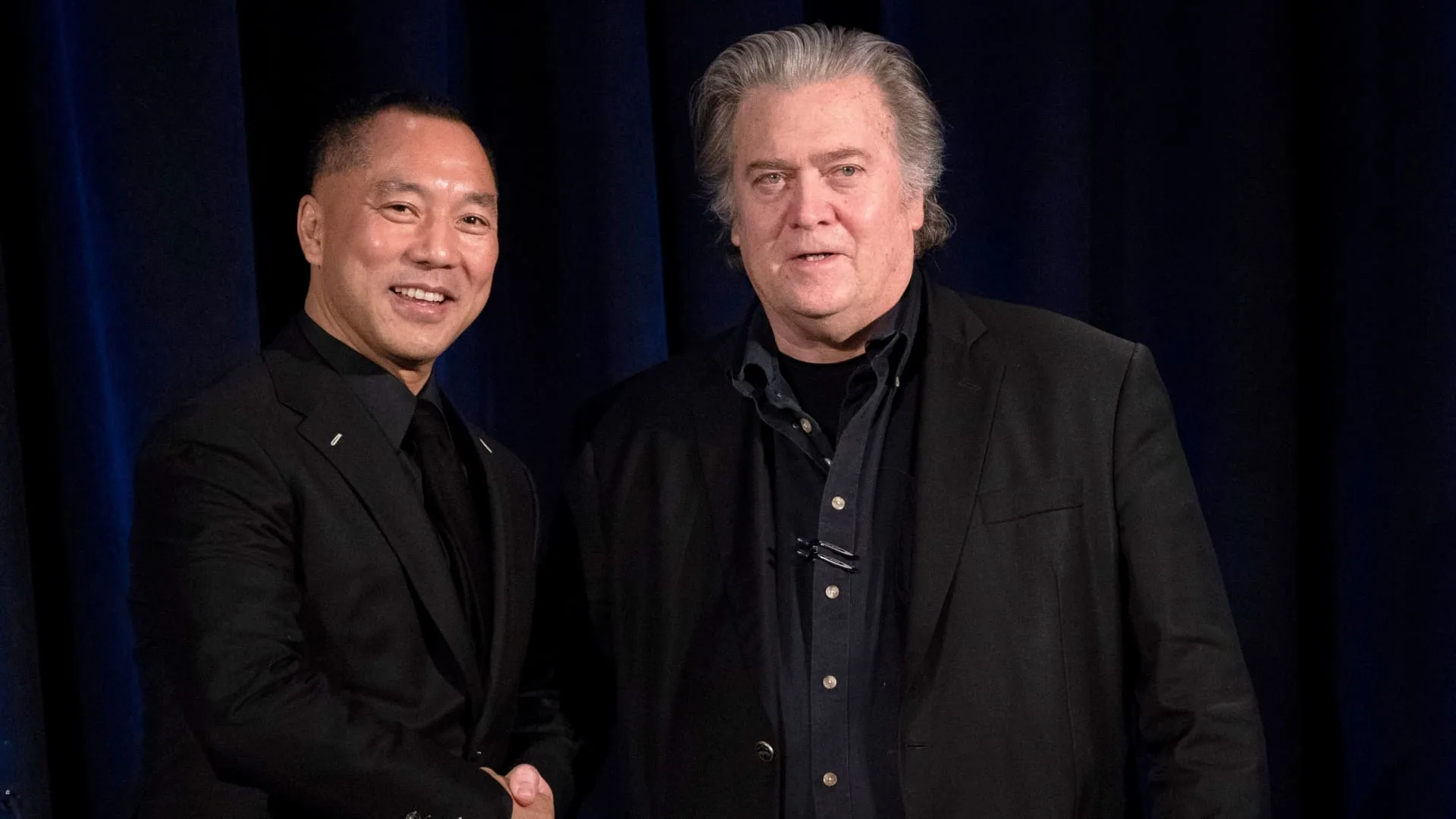
Former White House chief strategist Steve Bannon greets fugitive Chinese billionaire Guo Wengui before introducing him at a news conference November 20, 2018 in New York.

Don Emmert | AFP | Getty Images

Controversial exiled Chinese billionaire Guo Wengui – an aide to former Trump White House adviser Steve Bannon – was arrested in New York on Wednesday for allegedly orchestrating a complex $1 billion fraud scheme that fooled online followers with promises of outsized investment returns.

Guo reportedly used some of the money he raised through his company GTV Media and other companies to purchase a 50,000-square-foot mansion in New Jersey, a $37 million yacht, a $3.5 million Ferrari Buying a $140,000 Bösendorfer piano and two Hasten 2000T mattresses for his son cost a whopping $36,000 each.

Prosecutors seized more than $650 million in alleged fraud proceeds from 21 different bank accounts and assets, including a Lamborghini Aventador SVJ Roadster, as part of the case against Guo and his financial adviser William Je in federal court in Manhattan.

Guo, 52, is scheduled to appear in court on Wednesday afternoon.

A fire broke out when FBI agents searched a Manhattan penthouse apartment owned by Guo on Wednesday, an agency spokesman said. Agents noticed smoke from a light fixture and called ET 911 around noon.

The New York Fire Department extinguished the fire, the cause of which is being investigated by a bomb squad. Guo was in custody before the fire broke out.

CNBC Policy

Read more about CNBC’s political coverage:

  • Trump extends lead over DeSantis in new poll on possible GOP primary
  • Trump Super PAC accuses Ron DeSantis of ‘shadow’ presidential bid in ethics complaints
  • The DOJ is charging Chinese businessman Guo Wengui, associate of Steve Bannon, with $1 billion in fraud
  • Pfizer has to pay Medicare rebates for five drugs under the Biden plan to reduce Rx costs
  • Leading Senate Democrats are urging DOJ and SEC to investigate whether Silicon Valley Bank executives broke laws
  • Apple, Amazon and Google are likely to get a reprieve from the GOP-controlled house over antitrust legislation
  • Warren unveils bill to reverse Trump-era banking deregulation that she says led to the collapse of SVB and Signature
  • Chuck Schumer will donate campaign donations from ex-CEO of Silicon Valley Bank, PAC, to charity
  • Biden announces new plans to curb gun violence, months after the Lunar New Year mass shootings
  • Senate Democrats are asking Walmart, Costco, Albertsons and Kroger to sell the abortion pill mifepristone
  • Russian jet crashes US drone over Black Sea

The Securities and Exchange Commission separately filed a related civil lawsuit against Guo and 56-year-old Je, who resides in the United Kingdom and Hong Kong and remains at large. The SEC accuses Guo and Je of involvement in unregistered and fraudulent financial offerings.

The SEC separately accused Guo of making false statements when he raised hundreds of millions of dollars from investors through a cryptocurrency asset known as H-Coin.

Last September, three Guo-affiliated companies, including GTV Media, agreed to pay nearly $540 million to settle civil SEC allegations of illegal offerings of stocks and digital assets.

Guo, who goes by several different names including Miles Guo and Miles Kwok, Brother Seven and The Principal, has lived in the United States since 2015 after fleeing China, allegedly to avoid looming corruption charges.

In 2018, he founded two non-profit organizations, the Rule of Law Foundation and the Rule of Law Society, which engaged in a public relations campaign against the Chinese Communist Party.

Guo “used the charitable organizations to attract followers who were consistent with his purported political goals in China and who were also inclined to believe [Guo’s] statements regarding investment and money-making opportunities,” said the U.S. Attorney for the Southern District of New York in a statement on the criminal case.

Bannon, who served as senior White House adviser to former President Donald Trump for less than a year, served at times on the board of the Rule of Law Society.

In June 2021, Guo’s two nonprofits hosted a private party in New York attended by Bannon, former Trump attorney Rudy Giuliani, former Trump National Security Advisor Michael Flynn, and Trump ally and conspiracy theorist Mike Lindell, CEO from MyPillow, attended.

In August 2020, federal authorities arrested Bannon on one of Guo’s megayachts off the Connecticut coast on charges of diverting money to the We Build the Wall fundraiser. Months later, just before Trump left office, he pardoned Bannon in that case.

“Lady May” yacht, owned by Chinese billionaire Guo Wengui, in Long Island Sound.

NBC Connecticut

Last month, an attorney for Hunter Biden, son of President Joe Biden, sent Guo a letter demanding that he keep all records on Hunter Biden. The letter was sent two months after Mother Jones magazine detailed how, during his association with Giuliani, Bannon “had arranged for Guo and his followers to disseminate salacious videos and images of Hunter Biden’s laptop,” reported by a computer workshop in Delaware.

A 12-count grand jury indictment released Wednesday alleges Guo and Je “conspired to defraud thousands of victims” in the scheme, which spanned from 2018 to this month.

The alleged conspiracy involved using various facilities and programs to obtain investments from the victims, who were duped by false disclosures and misrepresentations, prosecutors said.

“Kwok has lied to its victims and promised them inflated returns if they invest or give money to GTV [Media]its so-called Himalaya Farm Alliance, G|CLUBS and the Himalaya Exchange,” prosecutors said in a press release.

Guo and Je are charged with wire fraud, securities fraud, bank fraud, and money laundering.

Je is also charged with obstruction of justice for allegedly trying to wire money related to the conspiracy to the United Arab Emirates since last September, after US authorities served seizure warrants on several banks to steal about $355 in proceeds to confiscate millions of dollars from the alleged fraud.

Both Guo and Je face up to 20 years in prison if convicted in the criminal case.

Gurbir Grewal, director of the SEC’s Enforcement Division, called Guo “a serial scammer who has raised more than $850 million by promising investors inflated returns on alleged crypto, technology and luxury investment opportunities.”

“In reality, Guo used the hype and attraction surrounding crypto and other investments to victimize thousands and fund his and his family’s lavish lifestyle,” Grewal said.

The SEC’s complaint said an example of Guo and Je’s alleged fraud was a private placement of GTV Media Group common stock.

“Guo and Je allegedly diverted $100 million in investor money to a hedge fund for the sole benefit of a company owned by Guo’s son,” the SEC said.

And Guo reportedly embezzled investor proceeds in two other bids to pay more than $40 million to purchase and renovate the New Jersey mansion and buy the Ferrari for his son, the SEC said.

— WNBC’s Jonathan Dienst contributed to the coverage

Nancy Meyer’s $130M Netflix movie has been shelved over finances points

Something must give.

Less than a year after the acclaimed rom-com filmmaker Nancy Meyer coyly confirmed that she’s signed a deal with Netflix to write and direct an untitled ensemble comedy, the streamer has reportedly shelved the highly-anticipated project.

The Hollywood Reporter, citing sources close to the situation, reported that the streaming service and the film director were unable to reach an agreement on the film’s budget. Though Nancy — whose works include Father of the Bride, The Parent Trap, Something’s Got To Give, and The Holiday — was aiming for a budget of at least $150 million, Netflix reportedly has a maximum of $130 million US dollars fixed.

The romantic comedy had already timidly attached major star power, including Scarlett Johansson, Owen Wilson, Penelope Cruz And Michael Fassbender. The story was supposed to revolve around a filmmaking couple who fell in love and were reunited after their split for a new project, according to the publication.

The update to Nancy’s latest rom-com comes almost eight years after the release of her last full-length film, when she co-wrote and directed the 2015 comedy-drama The Intern Anne Hathaway And Robert DeNiro.

Airline shares slide regardless of CEOs’ optimistic demand outlook

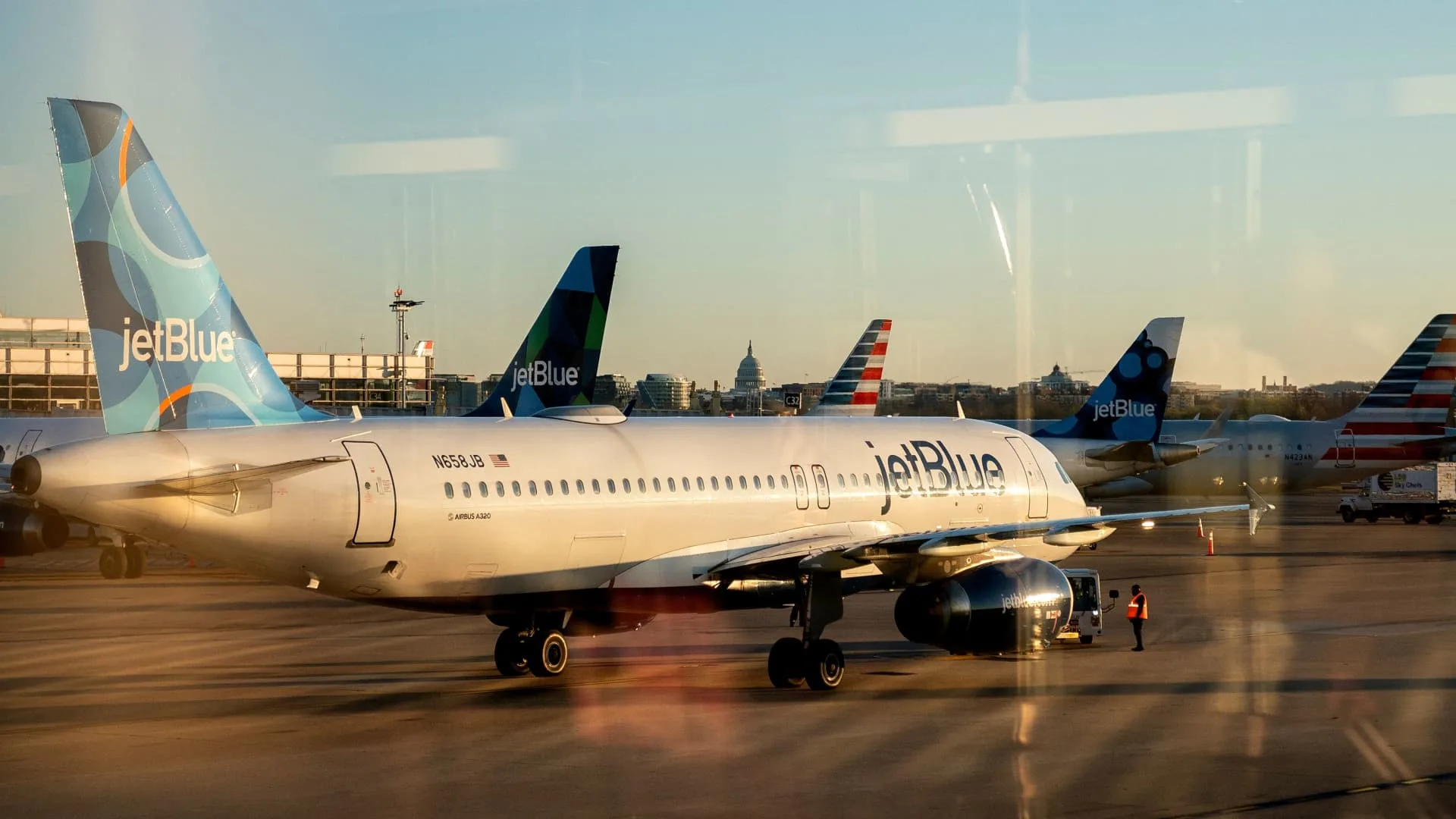
A JetBlue airplane at Ronald Reagan Washington National Airport in Arlington, Virginia on March 9, 2023.

Stefanie Reynolds | AFP | Getty Images

Airline stocks fell on Wednesday as the market fell across the board on worries about the health of some banks and new data showing a slowdown in consumer spending.

The NYSE Arca Airline Index, which includes mostly U.S. airlines, was down about 6% on Wednesday afternoon and was on course for its biggest one-day percentage decline since last June. It surpassed a drop in the S&P500.

Airlines executives said during a JPMorgan industry conference on Tuesday that despite higher costs, they expect strong demand — and profits — in 2023, with leisure travel continuing to lead. Consumer appetite for air travel has increased sharply over the past year, and higher fares have boosted airline profits.

However, the airlines also pointed to near-term problems such as higher spending on fuel and labour. United Airlines on Monday forecast a first-quarter loss on a potential new pilot deal and weaker-than-expected demand earlier this year, traditionally a weak travel season.

Some executives said lucrative business travel is shifting due to more hybrid work models that allow customers to combine work travel with leisure rather than using more traditional schedules.

“I think business travel has changed”, JetBlue Airways CEO Robin Hayes said at the conference. “Those day trips where you used to get up at 6 a.m. and be back by 8 p.m. … you just don’t do that anymore.”

Hayes said that means shifts in the network.

“We came in with 15 Boston LaGuardias because we thought it was a great idea. As it turns out, it wasn’t,” he said. “And that’s going to be nine or ten now as we get later in the year.”

Delta Airlines CEO Ed Bastian said business travel has recovered more than 80% of pre-pandemic levels.

“As I tell many of my CEO friends in and out of the industry, I know where your people are. They may not be in the office, but you can find them on my planes,” he said at the conference. “And that’s because of the new way of working, the new hybrid, the new mobility. And I don’t think that’s going to change.”

FDA Approves Pfizer’s Covid-Omicron Booster as Fourth Vaccine for Kids Beneath 5

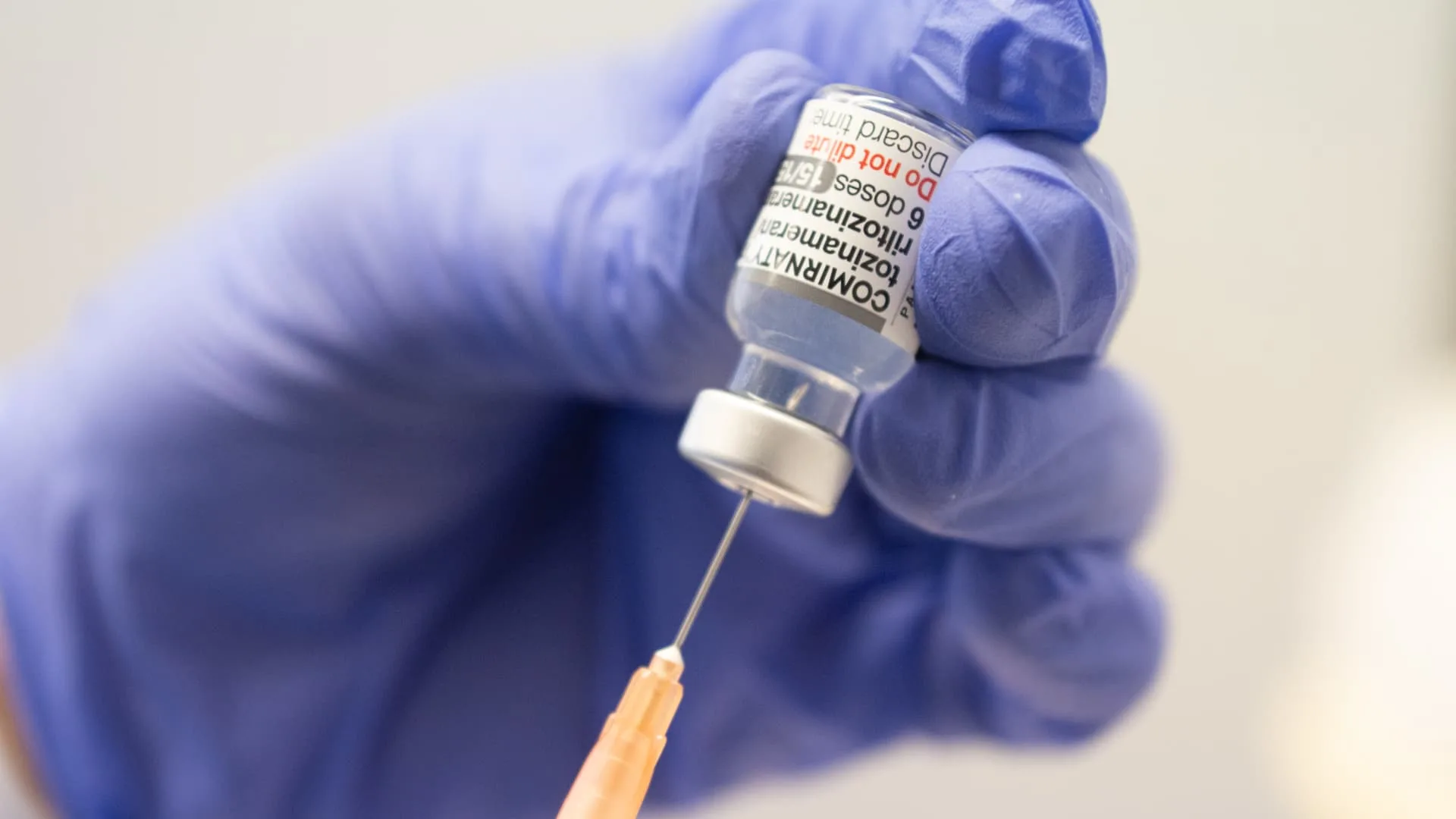
An employee at the Mainz vaccination center draws up a syringe with the Comirnaty vaccine from Biontech and Pfizer, adapted to the Omicron BA.1 variant.

Sebastian Christoph Gollnow dpa | Picture Alliance | Getty Images

The U.S. Food and Drug Administration approved it on Tuesday Pfizers omicron booster shot for children under the age of five who have previously been vaccinated with three doses of the company’s original vaccine.

Children ages six months to four years who completed their three-dose primary series more than two months ago with the original Pfizer and BioNTech monovalent syringes are now eligible for a single booster dose of the updated syringe. The new shot is bivalent, meaning it targets the original Covid strain as well as omicron BA.4 and BA.5.

Pfizer’s primary line for young children consists of three doses, while competing drugmaker Moderna’s primary line for the same age group consists of only two doses.

As of December, children in this age group who received two doses of Pfizer’s original vaccine are eligible to receive the omicron booster as the third dose or last dose in their primary series. The agency noted that children who received the Omicron shot as a third dose are not currently eligible for the bivalent booster but should still be protected against a severe case of Covid.

The new approval applies to young children who finished their three doses before the new injection was available.

“Today’s approval offers parents and caregivers of children ages 6 months to 4 years who received the three-dose primary series of monovalent Pfizer-BioNTech COVID-19 vaccine an opportunity to update their child’s protection by providing received a booster dose of Pfizer’s BioNTech vaccine. BioNTech COVID-19 Vaccine, Bivalent,” Peter Marks, director of the FDA’s Center for Biologics Evaluation and Research, said in a statement.

The agency’s decision aims to better protect young children after a cruel winter season that has seen hospitals overwhelmed with young children suffering from various respiratory diseases including Covid, RSV and the flu.

The FDA said the decision was based in part on clinical trial data from 60 children in the age group who had previously received three doses of Pfizer’s original vaccine and one dose of the company’s new booster shot. One month after the children received the omicron booster, they showed an immune response to both the original Covid strain and to omicron BA.5 and BA.5

Kevin McCarthy blames Biden for the financial institution collapse he helped trigger

House Speaker Kevin McCarthy plans to blame President Biden for the failure of Silicon Valley Bank despite pushing hard for 2018 deregulation.

Punchbowl News reports:

The House of Representatives GOP conference held a private debriefing call with Speaker Kevin McCarthy, House Financial Services Committee Chairman Patrick McHenry (RN.C.) and Rep. French Hill (R-Ark.).

Based on this conversation, we expect the party’s response to be something like – The Democrats are responsible for the collapse of these banks. Their historic spending created historic inflation, leading to historic rate hikes that the banks were unprepared for.

In the conference call, McCarthy blamed the Biden administration’s “failed” fiscal policy, coupled with rising interest rates, for the downfall of Silicon Valley Bank in particular. McHenry added that SVB’s collapse “in ‘It’s a Wonderful Life'” was “current social media meets bank rush scene.”

Subscribe to our newsletter:

Here is McCarthy’s video announcing the “Choice Act” which was the repeal of large parts of Dodd-Frank:

“#CHOICEAct could save $10 billion in annual regulatory costs and save 10.3 million hours of paperwork.” – @AAF https://t.co/KmoZZ9gt4w pic.twitter.com/tRgMFz0i4t

— Kevin McCarthy (@SpeakerMcCarthy) June 7, 2017

Here’s what McCarthy said in the House on June 8, 2017:

“The repeal of Dodd-Frank with the CHOICE Act puts people back in it so they can participate in America’s economy. It will restore the severed links that connect communities to the money they need to start businesses and hire employees. The return of the community banks destroyed by Dodd-Frank means more people, not just the rich, will have access to credit.

“The CHOICE Act levels the playing field. It holds both Wall Street and Washington accountable, lest their wrong decisions cost taxpayers money. And it makes things easy, so you don’t need an Ivy League law degree to understand the rules that govern our lives.

Kevin McCarthy claims his push for legislation weakened regulations that allowed Silicon Valley Bank to avoid oversight and stress testing. Kevin McCarthy promised less regulation of banks would be good for everyone.

Joe Biden is not to blame for the collapse of Silicon Valley. All political blame lies with Kevin McCarthy and Donald Trump.

Jason is the managing editor. He is also a White House press pool and congressional correspondent for PoliticusUSA. Jason has a bachelor’s degree in political science. His thesis focused on public policy with a specialization in social reform movements.

Awards and professional memberships

Member of the Society of Professional Journalists and the American Political Science Association