Blinken says U.S. has ‘not but seen’ proof of Iran involvement in Hamas assault on Israel

U.S. Secretary of State Antony Blinken testifies before the Senate Foreign Relations Committee on March 22, 2023 in Washington.

Kevin Dietsch | Getty Images News | Getty Images

U.S. Secretary of State Antony Blinken said Sunday that it is not clear there was any involvement by Iran in the weekend attack by Hamas on Israel.

Iran has long been a supporter of Hamas, the group designated by the U.S. as a terrorist organization, whose attack on Saturday left at least 250 in Israel dead.

“We have not yet seen evidence that Iran directed or was behind this particular attack, but there is certainly a long relationship,” Blinken said on CNN’s “State of the Union.”

Smoke billows following Palestinians’ respond to Israeli airstrikes with rockets from Gaza, in Gaza City, Gaza on May 10, 2023.

Ali Jadallah | Anadolu Agency | Getty Images

Some Republican leaders have pointed to Iran as a cause of the attack. Rep Michael McCaul (R-TX) said later on CNN that “we do know that Iran was behind this” but did not specify whether he was talking about specific information on this weekend’s attack or just the country’s historic support of Hamas in general.

One area of criticism of Blinken and the Biden administration has been the $6 billion the U.S. agreed in September to unfreeze for Iran to use only for humanitarian purposes as part of a swap of detainees. However, Blinken said Sunday that none of the $6 billion released to Iran has been spent.

Blinken also said the U.S. is working to verify reports that Americans were killed or are missing from the attacks. He added there could be news about requests for additional aid for Israel from the U.S. later on Sunday.

Israel’s Iron Dome air defense system intercepts rockets launched from Gaza City, on May 10, 2023.

Mohammed Abed | AFP | Getty Images

Israel has since struck back at Hamas, including strikes in Gaza, and the country’s Security Cabinet officially approved a “war situation.” The developments over the weekend have raised concerns that the conflict could widen to include other groups in the Middle East.

Blinken said there had been “limited firing” between Lebanon-based Hezbollah and Israel but “as of now, that’s quiet, but it’s something we’re watching very carefully.”

“Our first focus is to make sure Israel has what it needs to deal with the situation in Gaza. … At the same time, President Biden was very clear in sending a message to anyone in any other place who might try to take advantage of this situation, not to,” Blinken said.

Novavax Covid vaccine can nonetheless catch as much as Pfizer, Moderna pictures

A health worker prepares a dose of the Novavax vaccine as the Dutch Health Service Organization starts with the Novavax vaccination program on March 21, 2022 in The Hague, Netherlands.

Patrick Van Katwijk | Getty Images

Americans can finally get their hands on Novavax‘s newest Covid vaccine after U.S. regulators greenlighted the shot this week.

The vaccine’s arrival comes nearly three weeks after new jabs from Pfizer and Moderna reached the public, and after more than 4 million patients rolled up their sleeves to get a shot in September. But Wall Street analysts aren’t worried about that delay.

They said Novavax appears well positioned to catch up and compete this fall with the other companies in the U.S. Covid vaccine market, particularly after logistical issues hampered the rollout of the other shots and a Food and Drug Administration label that allows for wide accessibility to Novavax’s jab, among other factors.

“I’m really not concerned about the timeline or lag relative to the other shots,” B. Riley Securities analyst Mayank Mamtani told CNBC. He added that regulators cleared Novavax’s new shot only slightly later than what the company had estimated, which was late in the third quarter.

That’s good news for Novavax, which is working to strengthen its financial position after raising doubts about its ability to stay in business at the beginning of the year. The biotech company is banking on sales of its updated Covid vaccine — its only commercially available product — and a broad cost-cutting push to help it stay afloat. 

Public health officials see Novavax’s vaccine as a valuable alternative for people who don’t want to take messenger RNA shots from Pfizer and Moderna, which teach cells how to make proteins that trigger an immune response against Covid. Novavax’s shot fends off the virus with protein-based technology, a decades-old method used in routine vaccinations against hepatitis B and shingles.

Silvia Taylor, Novavax’s chief corporate affairs and advocacy officer, told CNBC that the company has collected data showing that 25% to 30% of people prefer a protein-based vaccine.

“We look forward to meeting this demand and more in the wake of new variants and rising COVID cases,” Taylor said in a statement.

Shares of Novavax jumped more than 10% on Tuesday after the FDA cleared its new shot. But the company’s stock is still down more than 25% year to date after shedding more than 90% of its value last year.

Novavax’s shot has a broad authorization label

The FDA authorized Novavax’s updated vaccine — which targets the omicron subvariant XBB.1.5 — for emergency use in people ages 12 and older. Patients previously vaccinated with an older Covid vaccine are eligible to receive one dose of Novavax’s new jab, while unvaccinated people can receive two doses, according to the authorization.

The FDA similarly approved the new shots from Pfizer and Moderna for people ages 12 and older, but the agency also authorized those vaccines for emergency use in children ages 6 months through 11 years old.

Still, Mamtani said the authorization label for Novavax’s new vaccine is “broad and without any notable restrictions for the first time,” which will likely make the shot as widely accessible to teens and adults as the new mRNA jabs. That puts Novavax on more of a level playing field with Pfizer and Moderna this fall, even as a late entrant to the game.

The label for Novavax’s last Covid booster was far more restrictive. Last year, the FDA authorized it as a first booster dose for people ages 18 and older who couldn’t receive a new mRNA shot for accessibility or clinical reasons. That “basically disqualified a lot of people” from getting it last fall, according to Mamtani. 

A health-care worker administers a dose of the Novavax Covid-19 vaccine at a pharmacy in Schwenksville, Pennsylvania, US, on Monday, Aug. 1, 2022.

Hannah Beier | Bloomberg | Getty Images

“Finally, after three years, Novavax has a label that puts its vaccine at parity with the mRNA shots,” Mamtani said. “I think the most powerful words on that label was that people can get it regardless of their previous Covid vaccination history.” 

Logistical issues slowed down Pfizer, Moderna

Novavax’s vaccine is entering the market after Pfizer and Moderna had a bumpy start to the rollout of their shots. Insurance and supply-related issues left many Americans unable to find or access the new mRNA vaccines for free, which may give Novavax an opportunity to catch up and get more people to take its shot. 

“We know that a lot of people have tried to get an mRNA vaccine, but they aren’t able to because of logistical challenges of access and distribution,” Jefferies analyst Roger Song told CNBC. “So, that’s one reason why the two or three weeks delay won’t necessarily be a hurdle for Novavax.” 

There’s no way of knowing whether the rollout of Novavax’s new shot will see similar logistical snags or if it will have a smoother launch. The federal government shifted Covid vaccine distribution and coverage to the private market for the first time this fall. That has proved to be a tricky transition for the U.S. health-care system. 

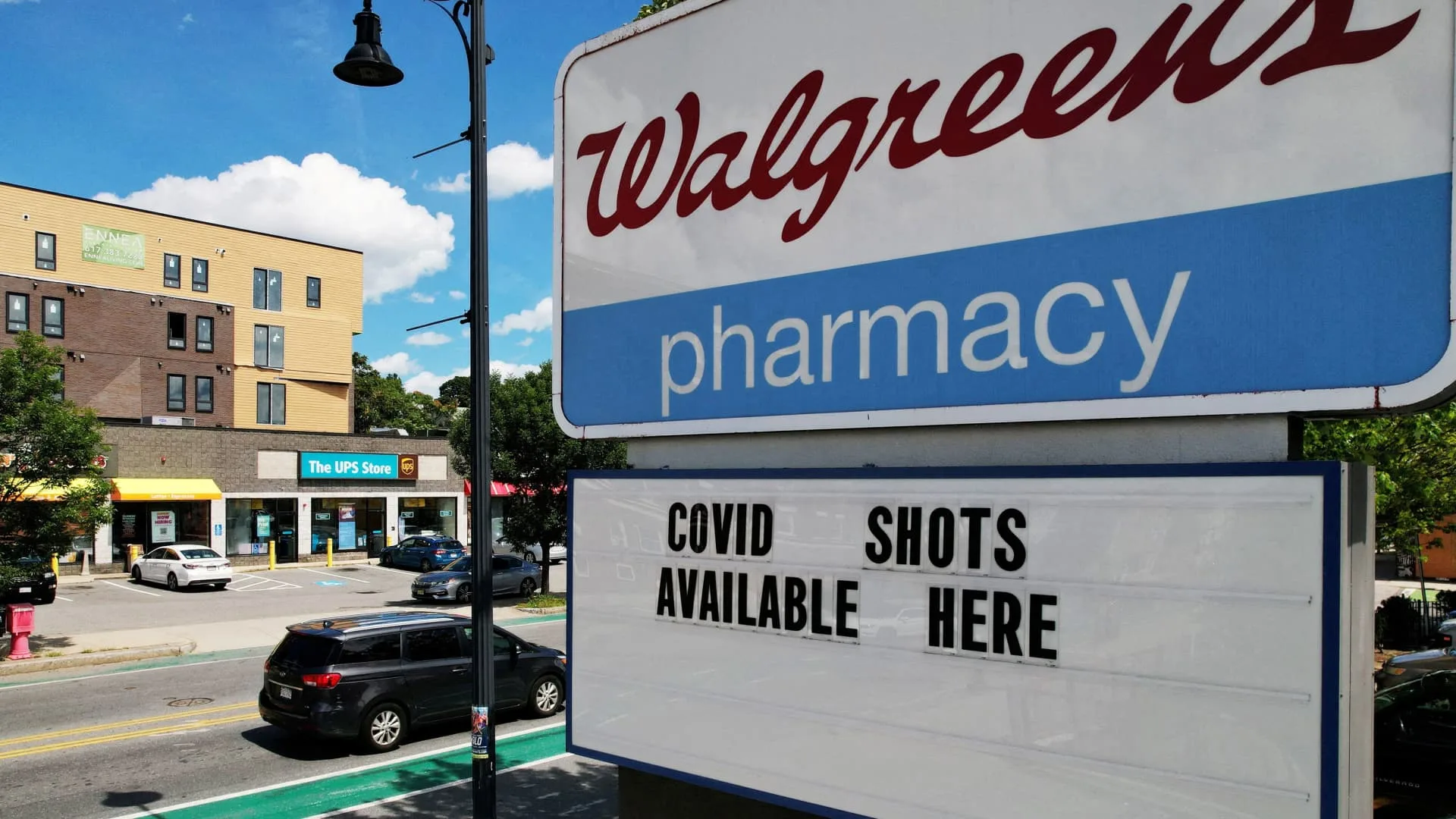
A sign advertises COVID-19 (coronavirus) vaccine shots at a Walgreens Pharmacy in Somerville, Massachusetts, August 14, 2023.

Brian Snyder | Reuters

However, health-care providers and pharmacies have signaled that they are ironing out logistical issues and will be better equipped to handle them in the future.

Last week, a group of insurers told the Biden administration they were “largely, if not completely,” done with fixing delays in insurance coverage for the new Covid shots. Those delays had resulted in some patients getting charged up to $190 for a shot at pharmacies.

“Should further issues arise, we stand ready to swiftly implement system improvements,” the insurers said in a letter. 

Some pharmacies, like Walgreens, also appear to be resolving supply disruptions, which left many stores without any new Covid shots for patients to receive.

Covid vaccinations could peak later this fall

What’s more, Novavax’s new shot might actually be arriving at just the right time: a month before Covid vaccine demand is expected to peak in the U.S. this fall and winter. 

Jefferies’ Song said the peak could follow a similar pattern as last season when most Covid boosters were administered in November. That’s partly because there is “less urgency” among Americans when it comes to Covid shots compared to early on in the pandemic, which could cause them to get vaccinated later rather than earlier.

“During the first season of Covid, everyone rushed to get vaccinations because it was really an emergency state. But now people have a mindset where they’re saying, ‘OK, I will wait and see how bad Covid really gets,'” Song said.

By November, Novavax’s new shot will likely be as widely available as shots from Pfizer and Moderna at pharmacies, doctor’s offices and other vaccine distribution sites. 

But the biggest uncertainty this fall for all three companies is how many Americans will decide to get another Covid vaccine, Song said.

Last year’s uptake was already feeble: Only about 17% of the U.S. population — around 56 million people — received last year’s boosters, according to the Centers for Disease Control and Prevention.

“We don’t know how big the overall pie will be because we’ve never been in a commercial market for Covid vaccines,” he told CNBC. “This fall will set a new benchmark for the entire Covid vaccine space.”

Da Brat Says Welcoming A Child w/ Jesseca Made Them ‘Stronger’

With Da Brat recently welcoming her first child — True Legend — with Jesseca “Judy” Harris-Dupart, the rapper is reflecting on embracing motherhood while relishing the new “bond” that the experience presents for the couple.

RELATED: So So Momma! Da Brat Welcomes Baby Boy With Jesseca Harris-Dupart

Da Brat Is Embracing All Aspects Of Being A Mother: “There’s No Love Like It”

The “Funkdafied” rapper shared her commentary with Entertainment Tonight at the 2023 BET Hip Hop Awards on Tuesday (Oct. 3).

Standing alongside Judy, Da Brat acknowledged that “there’s nothing like” motherhood.

“I just love being a mother. There’s nothing like it — there’s no love like it.”

Additionally, she shared that welcoming their son has made her bond with Judy “even stronger.”

“The bond that it creates between me and my wife and my son is just amazing. I didn’t think we could love each other more, but it’s even stronger.”

Then, the artist revealed that she’s enjoying all aspects of motherhood — including its messier side!

“I love motherhood. He pooped on me for the first time the other day and just shot out and got all over my clothes, and I just loved it!”

Highlighting The Rapper’s Recent Posts About True Legend: “I Am SO Grateful”

Da Brat’s commentary comes about three months after she and Jesseca Harris-Dupart welcomed their son. We should point out that the rapper was sure to recently come thru with a celebratory post in honor of National Sons Day, which is commemorated on Sept. 28.

She shared an Instagram video highlighting various pictures of her and True Legend, and her caption read, “I am SO grateful for my most beaurtifulest gift of my life.”

Da Brat went on to write, “Our yiddle MIRACLE boy brings us thee greatest joy. CHYYYLE I AM OFFICIALLY IN THIS CLUB NOW and I LOVE IT.”

Within another recent post, she shared a video of her holding True Legend and wrote, “Oh my goodness. I’ve never been so in love.”

She added, “GOD allowed ME to be this yiddle guys MOMMIE! I must’ve done something awesome in HIS eyes to be SO SO BLESSED this way.”

RELATED: Da Brat & Jesseca Harris-Dupart Unveil First Photos Of Newborn Son, True Legend

Amazon sellers pontificate on the FTC’s ‘long-overdue’ antitrust case

A worker sorts out parcels in the outbound dock at the Amazon fulfillment center in Eastvale, California, on Aug. 31, 2021.

Watchara Phomicinda | MediaNews Group | The Riverside Press-Enterprise via Getty Images

It was late in the day on Oct. 27, 2021, when Fred Ruckel received the dreaded automated email from Amazon.

Amazon’s software had detected that Ruckel’s popular cat toy, called the Ripple Rug, was being sold somewhere else for a cheaper price. His product would no longer be shown in Amazon’s all-important buy box, an area of the listing where shoppers click “Add to Cart.” Ruckel is the sole seller of the Ripple Rug on Amazon, so the move all but ensured his product would disappear from the website, costing him thousands of dollars per day.

“Below is a list of product(s) in your catalog that are not currently eligible to be the Featured Offer because they are not priced competitively compared to prices for those products from retailers outside Amazon,” according to the email, which was viewed by CNBC. 

Unbeknownst to him, Chewy was running a discount promotion, and dropped the price of his product by a few dollars to $39.99 – less than the $43 offer on Amazon. The algorithm had flagged it as a lower offer, even though the item on Chewy cost $48.54 after shipping and taxes. Ruckel had to make a choice: Lower the price on Amazon or ask Chewy to raise the price of his product. He opted for the latter.

Fred Ruckel’s company Snuggly Cat makes Ripple Rug, an interactive play mat for cats.

Fred Ruckel

Nearly three years later, Ruckel’s experience hits at the core of a sweeping antitrust lawsuit filed last week by the Federal Trade Commission against Amazon. The agency accused Amazon of wielding its monopoly power to squeeze merchants and thwart rivals. For consumers, that’s led to artificially inflated prices and a degraded shopping experience, the agency alleges. 

In the 172-page suit, the FTC said Amazon relies on an “anti-discounting strategy” and a “massive web-crawling apparatus that constantly tracks online prices” to stifle competition. The agency said Amazon punishes third-party sellers who offer cheaper products elsewhere by threatening to disqualify them from appearing in the buy box if it detects a lower price. Losing the buy box is an “existential threat” to sellers’ businesses, the complaint alleges. 

The end result of these tactics, the FTC argues, is elevated prices across the web. The company steadily hikes the fees it charges sellers and prevents them from discounting on other sites, so sellers often inflate their prices off of Amazon, creating an “artificial price floor everywhere,” according to the complaint.

The FTC is seeking to hold Amazon liable for allegedly violating anti-monopoly law, though it has not yet outlined the specific remedies it believes would best resolve its concerns. In antitrust cases, remedies are often determined only after a court finds the defendant liable.

In a blog post, Amazon general counsel David Zapolsky said third-party sellers set their own prices on the marketplace. The company also invests in tools to help sellers offer “competitive prices,” he said.

“Even with those tools, some of the businesses selling on Amazon might still choose to set prices that aren’t competitive,” Zapolsky said. “Just like any store owner who wouldn’t want to promote a bad deal to their customers, we don’t highlight or promote offers that are not competitively priced.” 

Zapolsky argued the FTC’s lawsuit could force it to stop highlighting low prices, “a perverse result that would be directly opposed to the goals of antitrust law.” 

“Long overdue” lawsuit

On Amazon’s own forum for merchants, called Seller Central, several users cheered on the FTC and said they hoped it would result in changes to the company’s business practices. Amazon’s tense relationship with merchants has been well-chronicled over the years, with sellers expressing a range of grievances over issues like rising fees, an arcane suspensions process, and heightened competition on the marketplace from all sides, including the e-commerce giant.

“I think it’s great, Amazon deserves it,” one person commented, adding, “More should be coming on the way.” Amazon in recent years made the forum anonymous, but users must have a seller account in order to post.

Another post included a screenshot of a message Amazon sent to sellers the day after the FTC filed its complaint, which said, “As your partners, we know that this news may generate questions for you and our business together. This lawsuit does not change anything about our relationship with you or how we operate today.”

One user called it “BS verbiage,” adding, “Businesses that sell in their store are indeed customers. And which of us has gotten good customer service?”

Another user described their experience in the last 12 months of selling on Amazon as “being up all night at an effing casino but I’m stuck, the drugs are starting to wear off, but I’m trying to break even on the mortgage payment I’m using to play. That’s how it is selling on Amazon right now to me.”

The seller went on to describe the experience as a “race to the bottom.”

“It’s long overdue,” another commenter wrote. “When they close me down, I’m applying for a job with the FTC.”

Still, others commented that the FTC’s complaint is misguided. “Selling on Amazon is a life-changing opportunity and the amount of sellers that throw stones at the platform is astounding,” one user wrote. 

Seller skepticism 

Even sellers who may be sympathetic to the idea of regulating Amazon have concerns, specifically that the FTC’s highlighted issues aren’t necessarily ones that would make the seller and consumer experience better.

Scott Needham, who sells on Amazon and runs a product-finder tool for other Amazon sellers, said he was “surprised by some of the points that the FTC selected.”

“I have over the years been very critical of Amazon,” Needham told CNBC. “I’ve lost a lot of sleep because of some of the things that they have done. And the issues that they brought up, while they are interesting, they haven’t created me a lot of pain.”

Needham said he was particularly puzzled by the inclusion of the claims that Amazon is coercive in the way it encourages sellers to use its fulfillment service, known as Fulfillment by Amazon, or FBA.

Needham said many sellers “love FBA” because of its compelling value in terms of the price and promise to deliver two-day shipping. For many, using FBA doesn’t feel like a requirement, but they believe using it will make their businesses “easier and more effective.”

“I think that the power that Amazon wields over sellers is considerable and absolutely worth looking into,” Needham said. “But I’m not sure if this would actually change that.”

Scott Moller, an Amazon seller and co-founder of an agency that helps merchants run their storefronts, said the e-commerce giant has removed some of the challenges that used to be part of running an online business. With FBA, he said, he can ship an item into one of Amazon’s warehouses for $7.49 per package, while shipping it himself through a traditional carrier would cost him about $12.

“I don’t have to have my own warehouse,” said Moller, who sells grilling accessories on Amazon under the brand Grill Sergeant. “I can use their staff, their storage, and I can instantly also take the data of advertising, so I can target ads.”

He also disputed the FTC’s claim that Amazon has become littered with ads in search results, causing shoppers to wade through potentially less-relevant products of lesser quality.

“We can tailor our ads to hit exactly the consumers we want,” Moller said. “It’s a perfect marriage of a transaction, and that’s one of the beauties of what their marketplace offers.” 

Needham said he feels he would have been more supportive of the case if it were filed a few years ago, pre-pandemic.

At that time, he said, “I would have felt, yes Amazon is a monopoly… But actually after Covid, into 2023, ecommerce has had a lot of big changes.” He added, “The competition is just not what it was in 2019.”

Competitors like Shopify and Walmart are increasingly viable alternatives for many categories of sellers, Needham said, not to mention rapidly growing Chinese e=commerce companies like Temu.

As a result, Needham said he’s seen some significant changes from Amazon. Among those is a greater ability for Amazon sellers to communicate with buyers, offering select customers certain promotions. Shopify, for example, gives sellers much more control over how they communicate with customers, Needham said, adding that although Amazon still controls the communication process, at least there is one.

“I wish it was a clear-cut case,” Needham said. “I have a vested interest in the marketplace doing really well, as a seller and as a service provider. And… this case, it doesn’t make the marketplace better for sellers.”

Concerns over Amazon pricing policies, fees

Many sellers have zeroed in on Amazon’s pricing policies and rising fees as rightful areas of concern in the FTC’s lawsuit.

Molson Hart, whose company Viahart sells toys on Amazon, has been a longtime critic of Amazon’s pricing policies. Hart complained of how Amazon’s seller fees impact pricing in a 2019 Medium post and later that year testified about his experience before a House committee.

Hart said Amazon sales comprise about 90% of his business, meaning any hit those sales take on Amazon has a considerable impact.

He recalled “24 anxious hours” in September 2022 when a third-party seller of his popular construction toy Brain Flakes listed the toy for a lower price on Target than it was offered on Amazon. 

Molson Hart, CEO of Viahart, an educational toy company that sells on Amazon.

Courtesy: Molson Hart

“When our product was suppressed on Amazon, we lost $4,000 worth of sales. And you face some negative effects after that,” Hart said. “It’s harder to find your product in search. When your product disappears from Amazon, it sort of damages it in search, as far as I can tell.”

Even Needham, who was not fully convinced about the direction of the FTC’s case, said he sees some issues with the buy box. He said that sellers often find it frustrating if another platform listing their product, such as Walmart, offers a promotion that decreases the price more than that of the Amazon listing, and if that happens, Amazon will often “suppress the listing” rather than “chasing down the price.”

Opponents of the lawsuit, such as Moller, argue that Amazon aggressively polices prices because it only wants to show the best deals on its site. 

“If Amazon discovers Walmart is selling my tool for $10 less, they’re going to say you need to match it,” Moller told CNBC. “The consumer is going to start on Amazon, then look elsewhere. Amazon wants to be a trusted marketplace, so to me, it’s a pro that they do this.” 

Still, Needham said he’s noticed instances where Amazon will highlight its own listing in the buy box rather than those of competing sellers, even when Amazon’s price is slightly higher and other sellers have the Prime badge.

“That is a very clear case of this is not what’s best for the consumer,” Needham said. “The consumer doesn’t know that they could be saving more money by buying from somewhere else on the Amazon platform.”

Needham said the pricing issue has forced him to scale back one of his businesses on Amazon that resells branded goods. In some cases, he said, he’d have to price the same products Amazon sells at about 10% lower than the e-commerce giant in order to effectively compete, which also creates an “opportunity cost.”

Hart isn’t very interested in seeing Amazon broken up, but he said that if the lawsuit “ultimately results in Amazon ending their pricing policy, I think that that would be a good thing.”

Ruckel, the pet toy maker, said he stopped selling on Amazon in January, fed up by not only what he called “anticompetitive price fixing,” but also the “tremendous fees” the company charges. He said he was driven over the edge by a recently-announced policy requiring sellers to pay a “remeasure fee” if a customer returns a package in a bigger box than what it was shipped in, or the box isn’t the same size as the item dimensions listed on the product page. 

Pulling the plug on Amazon wasn’t an easy decision, Ruckel said, estimating he’s lost $300,000 in sales in the time since he walked away from the platform. But he continues to sell on other platforms including Chewy, Etsy and his own website.

Despite the financial hit he expects to take this year, Ruckel said he feels he made the right decision. 

“It’s not good for your mental health to sell on Amazon,” he said. “You’re walking on eggshells every minute of the day.”

Amazon launches Mission Kuiper satellite tv for pc web prototypes

Your Amazon order of internet satellite prototypes have shipped.

More than four years since the tech giant announced its ambitious plan to invest heavily in building a global satellite internet network, Amazon on Friday saw the first pair of satellites for its Project Kuiper system launch into space.

“We’ve done extensive testing here in our lab and have a high degree of confidence in our satellite design, but there’s no substitute for on-orbit testing,” Project Kuiper vice president of technology Rajeev Badyal said in a statement before the launch.

United Launch Alliance Atlas V rocket carrying the first two demonstration satellites for Amazon’s Project Kuiper broadband internet constellation stands ready for launch on pad 41 at Cape Canaveral Space Force Station on October 5, 2023 in Cape Canaveral, Florida, United States. 

Paul Hennessey | Anadolu Agency | Getty Images

United Launch Alliance Atlas V rocket carrying the first two demonstration satellites for Amazon’s Project Kuiper broadband internet constellation stands ready for launch on pad 41 at Cape Canaveral Space Force Station on October 5, 2023 in Cape Canaveral, Florida, United States. 

Paul Hennessey | Anadolu Agency | Getty Images

Amazon twice switched rides for the pair of satellites before finally deciding to go with the immediately available, albeit far overpowered, Atlas V rocket for the Protoflight mission. Amazon originally planned to launch on ABL Space’s RS1 rocket, before delays in RS1’s development moved the satellites to United Launch Alliance’s Vulcan rocket, but delays to Vulcan’s debut moved the satellites to Atlas V.

Information about the size and design of the pair of Amazon’s satellites has been scarce – with the company only sharing photos of the shipping containers that delivered the spacecraft to Florida. Even ULA’s details about the launch are limited, with the info provided comparable to when the rocket company flies classified spy satellites for the U.S. government.

How Amazon's Project Kuiper is taking on SpaceX's Starlink satellite internet

Last year, Amazon announced the biggest corporate rocket deal in the industry’s history to launch Kuiper satellites, signing launch contracts with ULA, Arianespace, and Jeff Bezos’ Blue Origin. As part of that deal, Amazon expects to pay about $7.4 billion for Kuiper launches over the next five years. 

It has booked 77 launches – deals that include options for more launches when needed – from that trio of companies to deploy the satellites fast enough to meet regulatory requirements. That massive purchase has come under scrutiny from an Amazon shareholder lawsuit, which alleges the company snubbed SpaceX for valuable satellite launch contracts because of Jeff Bezos’ personal rivalry with Elon Musk.

Amazon is playing catch up to SpaceX, which has grown its Starlink satellite internet service to more than 2 million customers. Crucially, SpaceX says it is no longer absorbing the cost of the Starlink antennas it sells with the service, and the more than 5,000 satellites its launched so far now serve consumer, enterprise, and government customers.

Earlier this week, Amazon reiterated that its first production Kuiper satellites are on track to launch in the first half of next year – with plans to begin beta testing the network with customers by the end of 2024.

The “ultra-compact” version of the Project Kuiper

Amazon

Protoflight represents an “end-to-end” test of Kuiper. Amazon will look to verify the prototype satellites can connect to ground antennas and relay that connectivity on to its small customer terminals.

This year Amazon revealed a trio of satellite antennas that it plans to sell to Kuiper customers. The company has yet to say what it expects to charge customers for the hardware or service. Earlier field testing of Amazon’s Kuiper antennas saw download speeds of up to 400 Mbps.

The company’s main Kuiper facilities are near Seattle – in the Washington cities of Redmond and Kirkland. Amazon has other locations in San Diego, Austin, Texas, New York City and Washington, D.C.

Inside Amazon's satellite factory

Jim Jordan Is Lining Up Help To Run For Speaker

Rep. Jim Jordan (R-OH) is calling supporters and testing the waters for running to be the next Speaker of the House.

Jim Jordan News On Running For Speaker

Punchbowl News reported, “Rep. Jim Jordan (R-Ohio), the powerful Judiciary Committee chair and a conservative favorite, is making calls and sounding out supporters. It could get very interesting very fast if Jordan, who is aligned with McCarthy and being pushed by some of his allies, enters the race. A Jordan-Scalise speaker race would be one for the books.”

Jordan is aligned with McCarthy, as noted above, but he is also a favorite of the MAGAs. Back in January, Jordan was one of the names who was nominated for speaker before McCarthy was elected.

If Republicans are looking for the one person who can run the House in a more incompetent way than Kevin McCarthy, Jim Jordan would be their answer.

Jordan’s ‘Weaponization of Government’ hearings have been a disaster. Rep. Jordan has been a farce leading the House Judiciary Committee. If the goal of House Republicans is to totally abandon any pretext of governing and become a total freak show of extreme right-wing dysfunction, then Jim Jordan should be their leader.

Rep. Steve Scalise (R-LA) is also running for the job. While he certainly has the white supremacy cred that Republicans seem to require, there is already a whisper campaign being mounted against Scalise because he is currently being treated for cancer.

Whoever holds this job will likely have it for a little more than a year before Democrats take back the House, but Jim Jordan seems to be weighing a play for the gig.

Jason is the managing editor. He is also a White House Press Pool and a Congressional correspondent for PoliticusUSA. Jason has a Bachelor’s Degree in Political Science. His graduate work focused on public policy, with a specialization in social reform movements.

Awards and  Professional Memberships

Member of the Society of Professional Journalists and The American Political Science Association

Drugmakers comply with Medicare drug worth negotiations: What’s subsequent

A pharmacist holds a bottle of the drug Eliquis, made by Pfizer Pharmaceuticals, at a pharmacy in Provo, Utah, January 9, 2020.

George Frey | Reuters

All drugmakers of the first 10 medicines selected for Medicare drug price negotiations have agreed to participate in the talks, even after many of them sued to halt the process last month.

The companies confirmed their participation in separate statements to CNBC. The Centers for Medicare & Medicaid Services did not immediately respond to a request to confirm that all drugmakers agreed to the talks.

President Joe Biden’s Inflation Reduction Act, which passed last year, empowered Medicare to negotiate drug prices for the first time in the program’s six-decade history. The lengthy negotiation process won’t end until August 2024, with reduced prices going into effect in January 2026.

Sunday was the deadline for all 10 pharmaceutical companies to sign an agreement to engage in the negotiations, which aim to make costly medications more affordable for older Americans.

Monday, meanwhile, is the deadline for those companies to submit economic and market information on their drugs, including research and development costs and sales and revenue data. 

Here are the 10 drugs and the companies that manufacture them: 

  • Eliquis, made by Bristol Myers Squibb, is used to prevent blood clotting, to reduce the risk of stroke.
  • Jardiance, made by Boehringer Ingelheim, is used to lower blood sugar for people with Type 2 diabetes. 
  • Xarelto, made by Johnson & Johnson, is used to prevent blood clotting, to reduce the risk of stroke.
  • Januvia, made by Merck, is used to lower blood sugar for people with Type 2 diabetes.
  • Farxiga, made by AstraZeneca, is used to treat Type 2 diabetes.
  • Entresto, made by Novartis, is used to treat certain types of heart failure.
  • Enbrel, made by Amgen, is used to treat rheumatoid arthritis. 
  • Imbruvica, made by AbbVie, is used to treat different types of blood cancers. 
  • Stelara, made by J&J subsidiary Janssen, is used to treat Crohn’s disease.
  • Fiasp and NovoLog, made by Novo Nordisk, are insulins.

Many of the drugmakers contend that they had no real choice but to participate in the negotiations, specifically due to the penalties they could face if they choose not to.

If drugmakers decline to engage in the negotiations, they could be forced to pay an excise tax of up to 95% of their medication’s U.S. sales or to pull all of their products from the Medicare and Medicaid markets, according to CMS.

“We have no choice other than to sign the ‘agreement.’ If we did not sign, we’d be required to pay impossibly high penalties unless we withdraw all of our medicines from Medicare and Medicaid. That is not a real choice,” a spokesperson for Bristol Myers Squibb told CNBC ahead of the Sunday deadline.

That statement echoes the arguments outlined in at least nine separate lawsuits drugmakers filed against the Biden administration in recent months seeking to declare the negotiations unconstitutional.

The pharmaceutical industry also argues that the process will threaten revenue growth, profits and drug innovation.

However, analysts expect minimal financial losses for companies, at least initially, since most of the drugs selected already face upcoming patent expirations that will likely weigh on revenue.

What happens next?

This fall, CMS will host one meeting with all 10 companies so they can provide context for the data they submitted by Monday. 

CMS will also host listening sessions with consumer and patient organizations to obtain information the agency can use to develop its initial price offers for the selected drugs. 

CMS will then make an initial price offer to manufacturers in February, and the companies have a month to accept or make a counteroffer. 

The negotiations will end in August, with agreed-upon prices published on Sept. 1, 2024. The reduced prices won’t go into effect until Jan. 1, 2026.

After the initial round of talks, CMS can negotiate prices for another 15 drugs for 2027 and an additional 15 in 2028. The number rises to 20 negotiated medications a year starting in 2029 and beyond.

CMS will only select Medicare Part D drugs for the medicines covered by the first two years of negotiations. It will add more specialized drugs covered by Medicare Part B, which are typically administered by doctors, in 2028. 

The drug price talks are expected to save Medicare an estimated $98.5 billion over a decade, according to the Congressional Budget Office. 

The negotiations are also anticipated to save money for people enrolled in Medicare, who take an average of four to five prescription drugs a month and increasingly face out-of-pocket costs that many struggle to afford. 

Is the celebration over? New knowledge suggests revenge journey could also be ending quickly

The era of unabated “revenge travel” may be coming to a close.

New reports show that, after years of inflation and rising travel costs, travelers may finally be curtailing their travel plans.

A new report by the research company Morning Consult shows that travel intentions are increasing in several countries, but flatlining or falling in others, most notably in Europe.

Intentions to travel dropped 11 percentage points in France and six in Germany since 2022, according to Morning Consult’s “The State of Travel & Hospitality” report published in September.

Interest to travel also fell in Canada and Russia (-4 percentage points each), the survey showed.

Survey: Jan 2021-July 2023; 14,000 adults; margin of error +/-3%.

Source: Morning Consult

As to whether this suggests pent-up demand is ending: “Yes, our data suggests that is so,” said Lindsey Roeschke, travel and hospitality analyst at Morning Consult.

“That’s not to say that travel will decline significantly again, but … in short, the majority of those who were waiting to take their ‘revenge trips’ have already done so,” she said.

A slowdown may be more pronounced in Europe, said Roeschke.

“Much of this is related to the economy — inflation has eaten away at consumers’ savings in the past year and caused them to reprioritize how they spend,” she said.

An influx of North American tourists over the summer drove prices higher, making travel even more expensive for Europeans. Put together, this paints “a more pessimistic outlook on travel compared to other regions.”

‘Revenge travel likely to fade’

Pent-up demand was expected to have greater staying power in Asia-Pacific, where Covid border restrictions were kept in place longer than other parts of the world.

However, a new report by the economic advisory firm Oxford Economics says “short haul ‘revenge travel’ is likely to fade” in the region.

Pent-up demand fueled travel in Asia-Pacific in the first half of 2023, but since then, the trend is starting to reverse, it states, citing a drop in Singaporean visitors to Malaysia following a surge in late 2022.

“We expect similar, if less pronounced, dynamics for the rest of the region,” as an initial flurry of short-haul trips settles down, the report states.

The reports said arrivals from other parts of the world, especially the United States and Europe, are likely to wane too, as the delayed effects of tightening monetary policies hit travelers’ wallets.

“We are sticking with our call that the U.S. will enter recession around the turn of the year,” the report states. “Travel is for the most part a luxury good and among the first thing to be cut back when times get tougher.”

Chinese consumers ‘losing their gusto’

Pent-up demand in China is 'nowhere near as big' as it was in the U.S., says Nomura

But this level of fervor may not last, warns Oxford Economics.

“Chinese consumers are rapidly losing their gusto after the initial reopening spending spurt. High unemployment, negative wealth effects from the troubled property sector, and weak wage growth do not make a strong backdrop for splashing out on foreign holidays,” it states.

The report notes the risk that the longer Chinese tourists travel domestically, a permanent shift in travel preferences may occur among a population where international trips have lost some luster as a status symbol.

Most Chinese tourists are traveling within China and its special autonomous regions of Hong Kong and Macao. One week prior to Golden Week, standard rooms in 22 casino hotels in Macao were sold out for three of the eight-day holiday period, according to GGRAsia, a company that tracks Asia’s casino industry.

The boost purely from pent-up demand may soon run its course.

Moreover, interest among Chinese travelers to visit certain places is falling, according to Morning Consult’s report. Intentions to visit North America fell 23 percentage points from 2022 — far eclipsing a drop in interest from South Korea (12 percentage points) and Japan (9 percentage points).

“The drop in China is particularly concerning,” the report states. “While reasons are a mix of logistical (flight are scarce and expensive) and geopolitical (tensions are high between the U.S. and Chinese governments), the decline is a blow to destinations that were hoping for a more robust recovery.”

Fizzling pent-up demand

Outbound travel from China is set to continue growing, as flight and passport processing constraints ease. But it may not be enough to make up for the loss of travelers from other regions, according to Oxford Economics.

“The tourism boost to Asia has passed its peak,” the report states. “While mainland Chinese are very important to the region … growth in numbers is unlikely to be enough to stop the overall pace of the tourism recovery slowing in most places.”

“The boost purely from pent-up demand may soon run its course,” it states. “Consumers in advanced economies, particularly the U.S., will likely moderate their spending plans in the face of an uncertain economic environment. Others may follow as their home economies catch a cold.”

The travel industry remains bullish, however. A JLL survey published Thursday showed 77% of hotel owners and operators in Asia-Pacific anticipate a rise in occupancy levels in 2024.

Jake From State Farm Sits With Travis Kelce Mother and Cites Taylor Swift

Look what you made Jake From State Farm do.

Kevin Miles, who plays the character in the insurance commercials, sat next to Kansas City Chiefs tight end Travis Kelce‘s mom Donna Kelce as she cheered on her other son Jason Kelce at his team the Philadelphia Eagles’ home game against the Washington Commanders Oct. 1. And the actor could not help but make a reference to Taylor Swift, who has recently been spending time with Travis.

“In my red era with Mama MaAuto,” he tweeted alongside a photo of himself with Donna, referencing both the color of his State Farm-branded red jacket as well as the pop star’s 2012 album, plus part of a nickname given to Travis in a State Farm commercial that both men star in along with Chiefs quarterback Patrick Mahomes.

Kevin also posted a video of himself walking and talking with Jason, captioning the tweet, “We will not be discussing @JasonKelce’s Personal Price Plan. He did make me a great friendship bracelet tho!”—a reference to the accessories traded at Taylor’s Era Tour concerts this year.

Tips on how to purchase enterprise insurance coverage so monetary catastrophe would not strike

Many Main Street businesses could be playing with fire — literally — by not maintaining appropriate levels of business insurance coverage, especially given the spate of natural disasters affecting multiple areas of the U.S.

Skimping on property damage and business interruption coverage is understandable to some extent, given the cost. While the price of a business owner’s policy — designed for small businesses in low-risk industries — varies based on a variety of underwriting factors and optional coverages selected, generally speaking, a small business owner might pay somewhere between $500 and $3,500 per year for this type of policy, according to Pogo, which helps owners find insurance.

But pinching pennies can be foolhardy as climate change continues to impact the severity of weather-related events. As of Sept. 11, there had been 23 confirmed weather/climate disaster events this year with losses exceeding $1 billion each in the U.S., according to The National Centers for Environmental Information, which was above both the long-term and five-year annual averages. These events included two flooding events, 18 severe storm events, one tropical cyclone event, one wildfire event, and one winter storm event. 

Hurricanes don’t just happen in Florida and tornadoes don’t just touch down in Kansas, said John Hyland, who leads the Sentry Insurance unit that providers business insurance solutions. Especially with weather patterns changing, a natural disaster is “coming to your neighborhood more and more often,” he said. 

Consider Friday’s flash floods in New York as an example of this new reality.

Here’s what small businesses need to know about business insurance amid climate change:

Understand property damage exclusions and deductibles — the fine print matters more than ever.

There’s often a big disconnect between coverage business owners think they are getting and what they actually are getting, said Hubert Klein, partner and practice leader for the Financial Advisory Services Group at EisnerAmper. They should press for greater detail with insurance agents and know, for instance, what property damage is covered and what exclusions may apply. They should also know what their deductible is and when coverage kicks in. It’s also important to understand whether the policy covers the full cost of replacement cost and what limitations apply.

Owners also have to understand the nuances of business interruption coverage, which can include waiting periods, co-insurance requirements and provisions for civil authority bans, when certain areas are declared inaccessible after a disaster. 

The fine print matters, Klein said. He offers the example of a business with multiple locations and roughly $20 million of coverage. If there’s a $1.5 million per-location limit and the business suffers extensive damage to multiple facilities, the business may not be adequately covered. By contrast, a policy that has a blanket limit might be more favorable, even with a slightly lower limit overall, Klein said.

Don’t rely on a policy’s ‘summary’ info or opt for lower cost without a thorough understanding of coverages.

Many small businesses chase prices without understanding what they are giving up, Klein said. At renewal time, they may get sticker shock and ask for a premium reduction, but they don’t always understand there are trade-offs for a $300 or $3,000 policy reduction, he said. He recommends owners read their policy carefully, not relying solely on the summary of costs or summary of coverages. 

Run through likely weather scenarios and don’t expect to ‘beat the storm.’

To ensure they are appropriately covered, owners should perform a thorough evaluation of what could go wrong with respect to their business property, whether that’s fire, flood, hurricane or something else. This analysis should take into account how much cash the business owner has on hand in the event of a disaster.

Owners “tend to think they can outsmart the weatherman or beat the storm,” Klein said. 

Even businesses that aren’t directly affected by disasters can face unexpected issues. In the aftermath of Superstorm Sandy, for example, some businesses didn’t have direct damage to their facilities, but utility company issues left them without power for weeks, Hyland said. Businesses that were properly covered for this type of occurrence had a source of revenue to continue paying their employees and the other expenses, he said.

Decisions related to specific coverage, endorsements and deductibles will vary based on a particular business’s needs, but it’s important to understand the various exposures, Hyland said. Even if businesses decide not to purchase particular coverages, they shouldn’t be oblivious to the potential exposure, he said.

Conduct an annual review and include inflation in business valuation and property replacement cost estimates.

Inflation makes the cost of replacing property more expensive, and the coverage you planned for three years ago may no longer be appropriate given a changed price environment. Yet many businesses don’t re-evaluate their insurance needs and coverage yearly, Klein said. 

Most business policies build in inflation-adjustments, but they often aren’t enough to keep up with real-world scenarios such as supply issues, significantly higher labor costs and longer completion times, said Nancy Germond, executive director of risk management and education at The Independent Insurance Agents & Brokers of America.

Check if more emergency cash might be required in your geographic market.

In certain areas of the country, the deductible for perils related to fire, wind and hail are higher than deductibles for other covered events, said Jen Tadin, managing director of the global small business practice at Gallagher, an insurance brokerage and risk management consultant. Especially in riskier markets, business owners may have to keep more cash on hand than say 30 or even 45 days, especially when there are higher deductibles to consider. “We can’t change the fact that in Florida, you’ll have a higher deductible. But you have to plan for it,” Tadin said.